





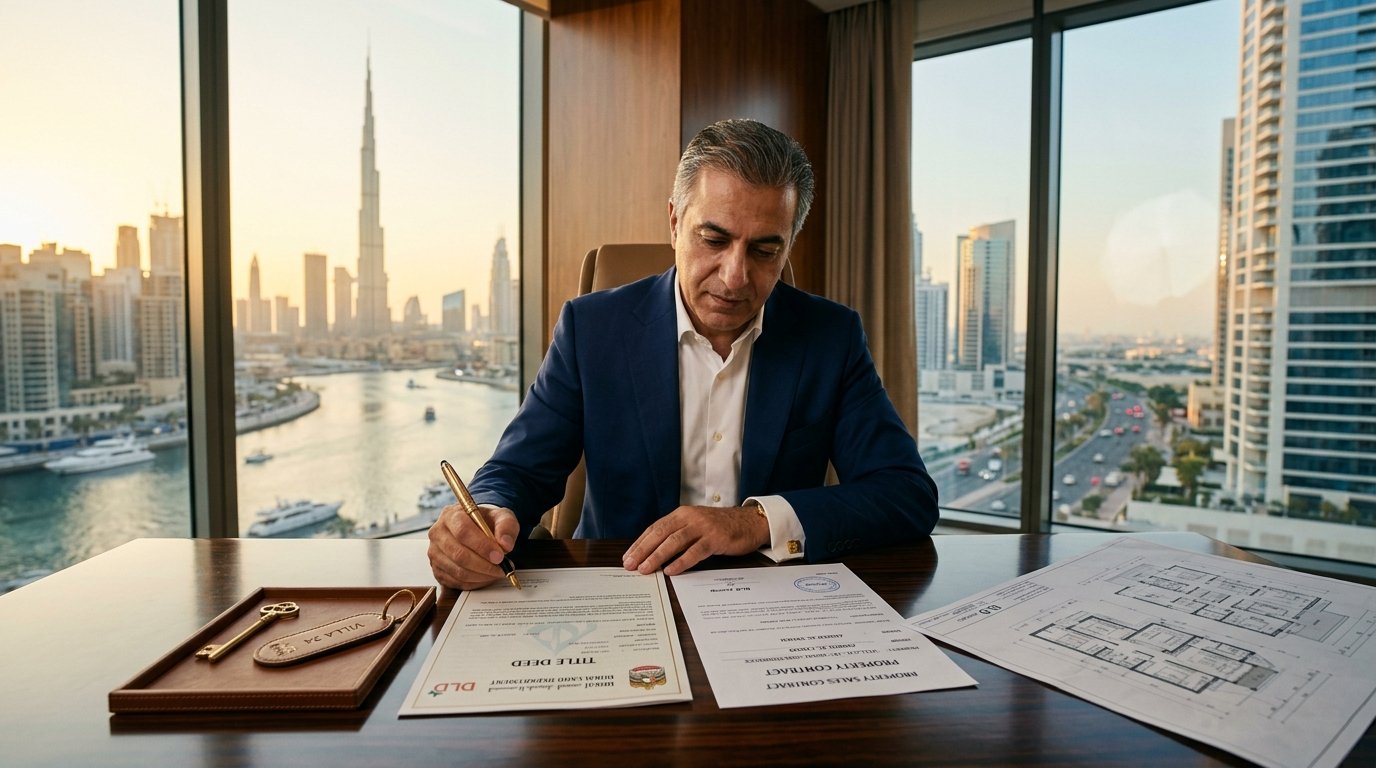
Dubai stands as the undisputed global capital of international real estate investment. Attracted by zero personal taxation, unmatched geopolitical stability, world-leading infrastructure, and resilient 7% to 10% rental yields, foreign nationals represent over 75% of all property transactions recorded by the Dubai Land Department (DLD). Yet, for first-time international buyers, navigating the legal nuances of foreign property ownership—from distinguishing between 100% Freehold and 99-Year Leasehold rights to mastering unified RERA contracts, statutory closing fees, and non-resident mortgage underwriting—can feel daunting.
Under the landmark provisions of Dubai Law No. 7 of 2006 concerning Real Estate Registration, the Government of Dubai eliminated historic barriers by granting foreign nationals of any citizenship the legal right to acquire absolute, perpetual freehold ownership in designated investment zones. Over the past two decades, this legal framework has evolved into the most secure, digitalized, and investor-transparent property ecosystem in the world, backed by audited developer escrow accounts, unified electronic contracts (Form A, B, and F), and direct linkages to the 10-Year UAE Golden Visa.
This definitive 2026 handbook provides an exhaustive, step-by-step masterclass on buying property in Dubai as a foreigner. Whether you are acquiring an off-plan waterfront villa from a master developer or closing a ready luxury penthouse in Downtown Dubai via a DLD Registration Trustee office, this dossier equips you with the legal clarity, fee schedules, tax structuring, and strategic negotiation tools required to execute flawless transactions.
1. Legal Architecture: Freehold vs. Leasehold vs. Usufruct Property Rights
The foundation of property acquisition in Dubai lies in understanding the statutory classification of land ownership rights granted under UAE federal civil codes and Dubai local legislation. The market recognizes three primary legal tenures:
1. Freehold Ownership (Absolute Foreign Rights)
Under Dubai Law No. 7 of 2006, non-UAE and non-GCC nationals are granted absolute, unencumbered freehold ownership rights in designated investment zones. A Freehold Title Deed confers perpetual legal ownership over both the physical building structure and the underlying land parcel upon which it is constructed. Freehold owners possess unconditional authority to lease, sell, mortgage, remodel, or transfer the asset to heirs through succession without any time limitations or government lease expirations.
2. Leasehold Ownership (Long-Term Leases)
Leasehold tenure grants the buyer the legal right to occupy and utilize a property for a predetermined term, typically ranging from 30 to 99 years. However, unlike freehold tenure, the buyer does not own the underlying land; legal title to the land remains with the original freeholder (often a UAE national or government entity). When the lease term expires, ownership reverts to the freeholder unless mutually renewed. Leasehold properties are commonly situated in older traditional districts such as Deira, Bur Dubai, and parts of Al Barsha.
3. Usufruct and Musataha Rights
Usufruct (governed under Article 1333 of the UAE Civil Code) grants the holder the right to use and exploit real estate belonging to another party for up to 99 years, with the statutory obligation to preserve the substance of the property. Musataha rights grant a developer or investor the legal right to construct and own buildings on another party’s land for up to 50 years (renewable). These structures are prevalent in specialized industrial, commercial, and educational free zones.
| Legal Property Tenure | Ownership Duration | Land Parcel Rights | Resale & Transferability | UAE Golden Visa Eligibility |
|---|---|---|---|---|
| Freehold (Designated Zones) | In Perpetuity (Forever) | Full ownership of building + land | Unconditional resale on open market | 100% Eligible (>= AED 2,000,000) |
| Leasehold | Up to 99 Years (Fixed Term) | Building occupancy only; zero land rights | Requires freeholder consent to assign | Ineligible for Property Golden Visa |
| Usufruct (Right to Use) | Up to 99 Years | Commercial exploitation; no land ownership | Restricted to contract parameters | Ineligible for Property Golden Visa |
| Musataha (Build & Operate) | Up to 50 Years (Renewable) | Right to construct; reverts to owner | Commercial transfer restrictions | Ineligible (Commercial license route only) |
2. Dubai Freehold Investment Zones: Master Directory for Foreign Buyers
Foreign buyers are legally permitted to acquire freehold real estate exclusively within areas officially designated by the Ruler of Dubai under Decree No. 3 of 2006 and subsequent executive gazettes. Today, these designated investment zones encompass virtually all of Dubai’s modern luxury residential, waterfront, and commercial districts:
| Prime Freehold District | Primary Master Developer | Core Property Typologies | Average Price / Sq. Ft. (AED) | Typical Gross Rental Yield (%) |
|---|---|---|---|---|
| Palm Jumeirah | Nakheel | Beachfront villas, branded penthouses, luxury apartments | AED 5,500 – 9,000+ | 5.8% – 6.8% |
| Downtown Dubai & Business Bay | Emaar Properties / Dubai Holding | High-rise luxury apartments, branded residences, canal penthouses | AED 2,500 – 4,200 | 6.8% – 8.2% |
| Dubai Marina & JBR | Emaar Properties / Select Group | Waterfront apartments, duplex penthouses, marina suites | AED 2,100 – 3,200 | 7.0% – 8.5% |
| Dubai Hills Estate | Emaar & Meraas | Championship golf villas, parkside townhouses, modern apartments | AED 2,200 – 3,400 | 6.5% – 7.8% |
| Dubai Islands | Nakheel | Beachfront villas, coastal townhouses, marina resort residences | AED 2,200 – 3,500 | 8.5% – 10.2% |
| Dubai South & Expo City | Dubai Aviation City Corp / Emaar South | Master-planned golf villas, townhouses, aviation city apartments | AED 1,200 – 1,750 | 8.2% – 9.8% |
| Palm Jebel Ali | Nakheel | Beach Collection & Coral Collection mansions, private frond estates | AED 2,500 – 3,450 | 6.5% – 7.5% (Post-Handover) |
In addition to the premier districts listed above, popular high-yield suburban freehold communities include Jumeirah Village Circle (JVC), Arjan, Al Furjan, Sobha Hartland, and Meydan. All properties in these master communities carry permanent freehold title deeds registered with the DLD.
3. Comprehensive Acquisition Fees & Government Transaction Costs Schedule
One of Dubai’s greatest appeals for international buyers is its transparent, low-friction transaction cost structure. Unlike major Western markets—where stamp duties, legal retainers, transfer levies, and notary charges can exceed 10% to 15% of the purchase price—Dubai’s total closing costs typically average between 6.5% and 7.5% of the property value.
The statutory fee breakdown for ready and off-plan real estate acquisitions is detailed below:
| Fee Component | Payable To | Statutory Rate / Amount (AED) | Responsible Party | Operational Inclusions |
|---|---|---|---|---|
| DLD Property Transfer Fee | Dubai Land Department | 4% of Purchase Price (+ AED 580 Admin) | Buyer (Standard practice) | Official state cadastre title deed registration |
| DLD Registration Trustee Fee | DLD Trustee Office | AED 4,000 + 5% VAT (Properties >= AED 500k) | Buyer | Government escrow signing & electronic title deed printing |
| Real Estate Brokerage Fee | RERA Certified Broker | 2% of Purchase Price + 5% VAT | Buyer (Secondary) / 0% on Off-Plan | Advisory, contract negotiation & conveyancing support |
| Developer NOC Fee | Master Developer (Emaar, Nakheel, etc.) | AED 1,000 – 5,000 + VAT | Seller (Standard) | No Objection Certificate clearing service charges |
| Oqood Registration (Off-Plan) | Dubai Land Department | 4% of SPA Value + AED 1,000 Admin | Buyer | Interim title registration protecting off-plan contract |
| Mortgage Registration (If Financed) | Dubai Land Department | 0.25% of Loan Amount + AED 290 | Borrower / Buyer | Statutory bank charge registration against title deed |
| Property Valuation Fee (Mortgage) | Lending Bank / Valuer | AED 2,500 – 3,500 + VAT | Borrower / Buyer | RICS-certified independent appraisal report |
Crucial Off-Plan Distinction: When buying off-plan property directly from a master developer, buyers pay 0% brokerage commission (developer pays agency compensation). Furthermore, developers frequently offer promotional incentives where they absorb 50% to 100% of the 4% DLD transfer fee (known as a “DLD Fee Waiver”), reducing total upfront closing costs to under 1%.
4. Step-by-Step Acquisition Workflow: Ready Secondary vs. Off-Plan
Foreign buyers must distinguish between acquiring a completed property on the secondary resale market versus purchasing an off-plan property directly from a developer under construction. The operational workflows, legal contracts, and escrow mechanisms diverge significantly:
| Process Stage | Ready Secondary Market Purchase | Off-Plan Direct Developer Purchase |
|---|---|---|
| 1. Agreement & Reservation | Sign unified RERA Contract F (Memorandum of Understanding) via Dubai REST app. Buyer deposits 10% security cheque. | Sign official Reservation Agreement and remit token booking deposit (AED 25,000 – 50,000) via wire transfer or credit card. |
| 2. Contract Execution | Both parties verify identity through Emirates ID or digital passport notarization. RERA Contract F generates unique transaction bar code. | Remit first down payment (10% to 20%) + 4% DLD fee within 14–30 days. Execute formal, legally binding Sales and Purchase Agreement (SPA). |
| 3. Clearance & Approvals | Seller applies for Developer NOC, confirming all service charges, maintenance fees, and building levies are fully cleared. | Developer registers transaction in DLD portal, issuing official Oqood (Interim Real Estate Registration) certificate. |
| 4. Financial Settlement | Buyer issues manager’s cheques payable to seller (purchase balance) and DLD (4% transfer fee + trustee fees). | Buyer remits construction milestone installments directly into project-specific RERA Escrow Account per payment schedule. |
| 5. Final Title Transfer | Physical or remote transfer at DLD Registration Trustee Office. Seller signs over title; buyer receives official digital Title Deed. | Upon construction completion and Building Completion Certificate (BCC) issuance, Oqood is converted into permanent Freehold Title Deed. |
Remote Buying Capability: Non-resident foreign investors do not need to physically travel to Dubai to complete a purchase. Off-plan contracts are executed via DocuSign or developer secure digital portals, and secondary transfers can be finalized via an attested Power of Attorney (POA) issued through a UAE Embassy or online via Dubai Courts digital notary.
5. The Unified RERA Contract Ecosystem: Form A, Form B, and Form F Decoded
To eliminate fraud and ambiguous verbal agreements, the Dubai Land Department and the Real Estate Regulatory Agency (RERA) mandate the use of standardized electronic contracts. Every real estate transaction on the secondary market must be formalized through the unified contract system accessible via the official Dubai REST mobile application:
The Three Core RERA Unified Contracts:
- RERA Form A (Seller – Broker Agreement): The legally mandated listing contract executed between the property owner and the licensed brokerage firm. Form A specifies listing price, marketing channels, commission percentage, and exclusivity parameters. Without an active Form A registered in the DLD Trakheesi system, marketing a property in Dubai is strictly illegal.
- RERA Form B (Buyer – Broker Agreement): The representation agreement executed between the prospective purchaser and their appointed property advisor. It defines the search scope, buyer advisory responsibilities, and commission obligations (typically 2% + VAT).
- RERA Form F (Memorandum of Understanding / Sales Agreement): The apex purchase contract executed directly between the buyer and seller. Form F codifies the agreed purchase price, down payment deposit, mortgage contingency clauses, developer NOC clearance timelines, and the designated closing date at the Registration Trustee office.
Once generated digitally on the Dubai REST app, Form F requires digital biometric or one-time-password (OTP) signatures from both the buyer and seller. The document automatically creates a unique transaction bar code registered in the government cadastre, protecting the buyer’s equitable interest in the property during the conveyancing phase.
6. Inside the DLD Registration Trustee Office: The Anatomy of Transfer Day
In Dubai, property conveyancing does not drag on through months of postal correspondence between opposing solicitors. Secondary market transfers culminate in an efficient, transparent closing session conducted at an authorized DLD Real Estate Registration Trustee Office. Licensed by the government, Trustee offices act as quasi-notary legal escrow centers.
The closing appointment typically takes between 45 and 90 minutes and follows an exact statutory protocol:
- Identity & Document Verification: The Trustee officer verifies original passports and Emirates IDs of all parties. The original Title Deed and the official developer No Objection Certificate (NOC) are uploaded into the central DLD registry.
- Existing Mortgage Redemption (If Applicable): If the seller holds an active mortgage, the buyer’s funds or the buyer’s lending bank must issue a manager’s cheque directly to the seller’s bank to redeem the outstanding debt, followed by an electronic mortgage discharge clearance issued by DLD.
- Surrender of Manager’s Cheques: The buyer hands over certified UAE Manager’s Cheques (banker’s drafts) for the remaining purchase price balance payable directly to the seller, alongside the 4% transfer fee payable to the Dubai Land Department and the AED 4,200 administrative fee payable to the Trustee office.
- Electronic Title Deed Generation: The Trustee officer executes the transfer in the central government cadastre. The seller’s Title Deed is immediately deactivated, and a brand-new digital Freehold Title Deed is generated instantly under the buyer’s legal ownership, dispatched via official DLD SMS and email with an encrypted QR verification code.
7. Executing Purchases Remotely: Power of Attorney (POA) Guidelines
International investors are not legally required to be physically present in Dubai to complete a property transaction. A designated representative or legal counsel can execute the entire purchase on the buyer’s behalf through a legally registered Power of Attorney (POA).
Foreign buyers can execute a POA through two established legal pathways:
- Pathway 1: Dubai Courts Digital Online Notary (Fastest): Non-resident buyers can participate in a scheduled digital video verification session directly with a Dubai Courts Notary Public. With passport verification and identity confirmation, a bilingual Arabic-English POA is notarized and registered electronically within 24 to 48 hours without visiting an overseas embassy.
- Pathway 2: Traditional Consular Legalization Chain: If executing locally in the buyer’s home country, the POA must be notarized by a local notary public, authenticated by the home country’s Ministry of Foreign Affairs, legalized by the UAE Embassy or Consulate, and stamped by the UAE Ministry of Foreign Affairs (MOFA) upon arrival in Dubai, followed by sworn Ministry of Justice Arabic translation.
Important Conflict of Interest Protection: Under strict RERA regulatory guidelines, an appointed real estate broker or property agency cannot act as the legal Power of Attorney holder for a transaction in which they are also acting as the representing broker. The POA must be granted to an independent third party, family member, or certified conveyancing lawyer.
8. Non-Resident Banking, Currency Peg & Wire Transfer Security
Can a foreign national living outside the UAE obtain a mortgage to purchase property in Dubai? Yes. Major UAE commercial banks (including Emirates NBD, First Abu Dhabi Bank, Mashreq, Abu Dhabi Commercial Bank, and HSBC UAE) actively lend to non-resident foreign investors, subject to strict Central Bank of the UAE regulatory parameters:
| Mortgage Parameter | UAE Resident Expatriates | Non-Resident Foreign Investors | Regulatory Authority |
|---|---|---|---|
| Maximum Loan-to-Value (LTV) | Up to 80% (Properties under AED 5M) | Up to 60% – 65% (Requires 35% – 40% equity) | Central Bank of the UAE (CBUAE) |
| Prevailing Interest Rates | 4.2% – 5.2% (Fixed 3-5 years) | 5.0% – 6.2% (EIBOR + 1.75% to 2.5% margin) | Commercial Lending Spreads |
| Maximum Loan Tenure | Up to 25 Years (Subject to age 65 cap) | Up to 20 – 25 Years (Subject to age 65 cap) | CBUAE Lending Norms |
| Debt-to-Burden Ratio (DBR) | Capped at 50% of monthly income | Capped at 50% of verified overseas income | CBUAE Risk Guidelines |
| Required Financial Proof | UAE salary certificate, 6-mo bank statements | 6-mo overseas bank statements, tax returns, audited company financials | Bank Underwriting Mandate |
For non-resident investors, obtaining mortgage pre-approval typically takes 7 to 14 business days. However, because approximately 80% of foreign buyers in Dubai transact entirely in cash or utilize developer interest-free off-plan payment plans, mortgage underwriting is rarely a mandatory obstacle.
6. Tax Structuring: 0% Personal Income Tax & Wealth Optimization
Dubai’s fiscal regime is globally celebrated as a premier zero-tax haven. For international property investors, the tax advantages are unmatched:
- 0% Personal Income Tax: The Government of Dubai does not levy any personal income tax on residential or commercial rental yields. 100% of your gross rental income (after operational expenses) belongs to you.
- 0% Capital Gains Tax: When you sell your property at a substantial profit—whether on an off-plan contract assignment or secondary resale—the capital appreciation is realized completely tax-free.
- 0% Annual Property Holding Tax: Unlike the United States (where annual property taxes can reach 2% to 3% of market value) or the UK (council taxes), Dubai charges zero recurring property taxes. Property owners pay only standard utility tariffs and building service charges.
- 0% Estate & Inheritance Tax: Dubai does not impose death duties or inheritance taxes on real estate assets. Foreign non-Muslim property owners can register a legally binding English-language Will through the DIFC Wills Service Centre, ensuring their assets pass seamlessly to designated heirs without applying Sharia inheritance distributions.
7. Strategic Investor Due Diligence: 5 Essential Rules for Foreign Buyers
To safeguard capital and guarantee superior risk-adjusted returns, foreign buyers should apply the following five golden rules of due diligence:
- Verify Developer & Project Escrow via the Dubai REST App: Before remitting any funds for off-plan property, verify that the project is officially registered with RERA and that payments are directed strictly into the designated project Escrow Account. Never wire down payments to personal broker accounts or unverified private company accounts.
- Insist on RERA-Licensed Brokers with Valid BRN Numbers: Ensure your real estate advisor holds an active Broker Registration Number (BRN) issued by the Real Estate Regulatory Agency. Licensed brokers are legally bound to uphold RERA professional ethics codes and unified contract protocols.
- Scrutinize Historical Service Charges on the DLD Mollak System: Recurring service charges directly impact net rental yields. Audit the building’s historical service charge rates on the DLD Mollak electronic portal to avoid unexpected operational inflation.
- Structure Purchases to Meet the AED 2M Golden Visa Minimum: If securing long-term UAE residency is a priority, structure your property acquisitions—individually or combined—to equal or exceed AED 2,000,000. Under updated 2026 regulations, even off-plan or mortgaged properties qualify immediately with zero minimum down-payment constraints.
- Register a DIFC Will for Asset Succession: Protect your multi-million-dirham property portfolio by executing a non-Muslim Will registered with the Dubai International Financial Centre (DIFC) Courts. This ensures full common-law testamentary freedom and shields assets from jurisdictional probate delays.
9. Non-Resident Banking, Currency Peg & Wire Transfer Compliance
Managing international fund transfers and establishing local banking relationships are pivotal steps for foreign property investors. The United Arab Emirates enforces a world-class financial regulatory regime overseen by the Central Bank of the UAE (CBUAE):
Opening a UAE Bank Account as a Non-Resident Property Owner
Foreign property owners holding a registered Title Deed or Oqood certificate can open a Non-Resident Personal Savings Account with premier UAE financial institutions, such as Emirates NBD, First Abu Dhabi Bank (FAB), Mashreq, and Abu Dhabi Commercial Bank (ADCB). While non-residents are typically issued debit cards rather than local chequebooks, these accounts provide multi-currency capabilities (AED, USD, EUR, GBP), internet banking, and direct international SWIFT wire privileges.
Standard documentation required by UAE bank compliance departments includes:
- Original passport with UAE entry stamp or visit visa.
- Six months of original, verified personal bank statements from the applicant’s home country.
- Proof of residential address (recent utility bill or government council tax statement).
- Proof of income / source of wealth (audited corporate accounts, employment salary certificate, or investment dividends).
- Copy of the registered Dubai Property Title Deed or Sales and Purchase Agreement (SPA).
The Ironclad USD-Dirham Currency Peg
A major structural security feature for global investors is the statutory currency peg between the United Arab Emirates Dirham (AED) and the United States Dollar (USD). Since November 1997, the exchange rate has remained legally fixed at exactly 1 USD = 3.6725 AED. For dollar-denominated global investors, this eliminates currency volatility risks, ensuring predictable cash flows and protected capital valuations.
10. The Foreign Landlord’s Playbook: Ejari, RERA Tenancy Laws & Yield Management
Once a foreign investor acquires a ready property, monetizing the asset through long-term annual leasing or short-term holiday rentals is governed by transparent statutory mechanisms:
Mandatory Ejari System
Under Dubai Law No. 26 of 2007 (regulating relationships between landlords and tenants), every residential lease agreement must be registered electronically on the Ejari system (administered by the DLD). Ejari codifies the unified tenancy contract, deposit sums, payment cheque schedules, and tenant identities. An active Ejari certificate is legally required for tenants to connect municipal electricity and water (DEWA), secure telecommunications, and sponsor domestic family visas.
The RERA Rental Calculator & Rent Increase Protections
Landlords in Dubai cannot arbitrarily raise rents upon lease renewal. Rent adjustments are governed by the official RERA Rental Increase Calculator (Decree No. 43 of 2013). Under statutory formulas, rent hikes are permitted only if the current contract rate is at least 10% below the benchmark average rent for equivalent properties in that specific community. Landlords must issue a formal 90-day written notice prior to lease expiration to adjust renewal terms.
Rental Disputes Center (RDC) Judicial Protection
In the rare event of tenant default, non-payment, or breach of contract, landlord rights are enforced through the Rental Disputes Center (RDC), a specialized judicial tribunal of the Dubai Court system. RDC operates with digital filings and expedited arbitration, resolving disputes and issuing enforceable eviction judgments within 30 to 45 days, shielding foreign property owners from protracted common-law litigation.
11. Construction Completion: Defect Liability & Decennial Structural Warranties
For foreign buyers acquiring off-plan property, taking handover involves statutory consumer protections codified under UAE law:
- 1-Year Defect Liability Period (DLP): Under standard DLD contracts, developers are legally obligated to rectify all architectural, cosmetic, and MEP (mechanical, electrical, plumbing) defects free of charge for a minimum period of one calendar year following the date of the Building Completion Certificate (BCC). Buyers should hire a certified independent snagging surveyor to inspect the unit and produce an official rectification report before signing handover acceptance.
- 10-Year Decennial Structural Liability (Article 880 UAE Civil Code): Developers and main structural contractors bear joint strict liability for ten years post-handover for any total or partial collapse of the building structure, or any latent structural defects that threaten the stability and safety of the building. This provides foreign buyers with long-term capital preservation protections equivalent to French and Swiss civil law standards.
📌 Strategic Investment Reading & UAE Market Analysis
Explore our verified investor resources to navigate UAE freehold opportunities, visas, and master developments:
- UAE Golden Visa Real Estate Regulations: 2M AED Criteria & Off-Plan Thresholds
- Palm Jebel Ali (Nakheel) Complete Investment Guide: Frond Villa Prices & Master Plan
- Dubai Hills Estate Property Guide: Villa vs Apartment Prices & Rental Yields
- How to Resell Off-Plan Property in Dubai: RERA Minimum Equity & NOC Process
- Dubai South & Al Maktoum Airport (DWC) Boom: Expo City & ROI Analysis
12. Frequently Asked Questions (FAQ)
Can a foreigner buy property in Dubai without UAE residency?
Yes. Foreign nationals of any nationality or citizenship can purchase property in Dubai with 100% freehold ownership without requiring a UAE residency visa, Emirates ID, or local business license. All that is legally required is a valid passport.
What is the total fee percentage when buying property in Dubai?
Total transaction costs typically average approximately 6.5% to 7.0% of the purchase price on ready secondary properties, comprising the 4% Dubai Land Department transfer fee, 2% agency brokerage fee (+ 5% VAT), AED 4,200 Registration Trustee fee, and miscellaneous administration charges. On off-plan direct developer purchases, buyers pay 0% agency fees and often benefit from 50% to 100% DLD fee waivers.
Can a foreigner buy property in Dubai remotely from overseas?
Yes. Off-plan contracts can be executed electronically via digital developer portals and international bank wire transfers. Secondary market transfers can be completed through an attested Power of Attorney (POA) or through DLD’s digital online trustee transfer system.
Does buying property in Dubai automatically grant residency?
Property purchases valued at AED 750,000 or more qualify the owner for a 2-Year Taskeen Property Visa. Purchases valued at AED 2,000,000 or greater qualify the investor and their immediate family for the prestigious 10-Year Renewable UAE Golden Visa, with no minimum time required to stay inside the country.
Are rental yields and capital gains taxed in Dubai?
No. The UAE levies 0% personal income tax, 0% capital gains tax, and 0% property holding tax on real estate earnings. Investors receive 100% of their net rental cash flow and capital appreciation tax-free.
Execute Your Dubai Property Acquisition with Confidence
From selecting top-tier freehold communities to contract conveyancing, escrow verification, and 10-Year Golden Visa processing, Vintage Luxe delivers bespoke private client advisory for international investors. Contact our senior property specialists today for exclusive access to pre-market developer launches and institutional portfolio advice.



Comments are closed