





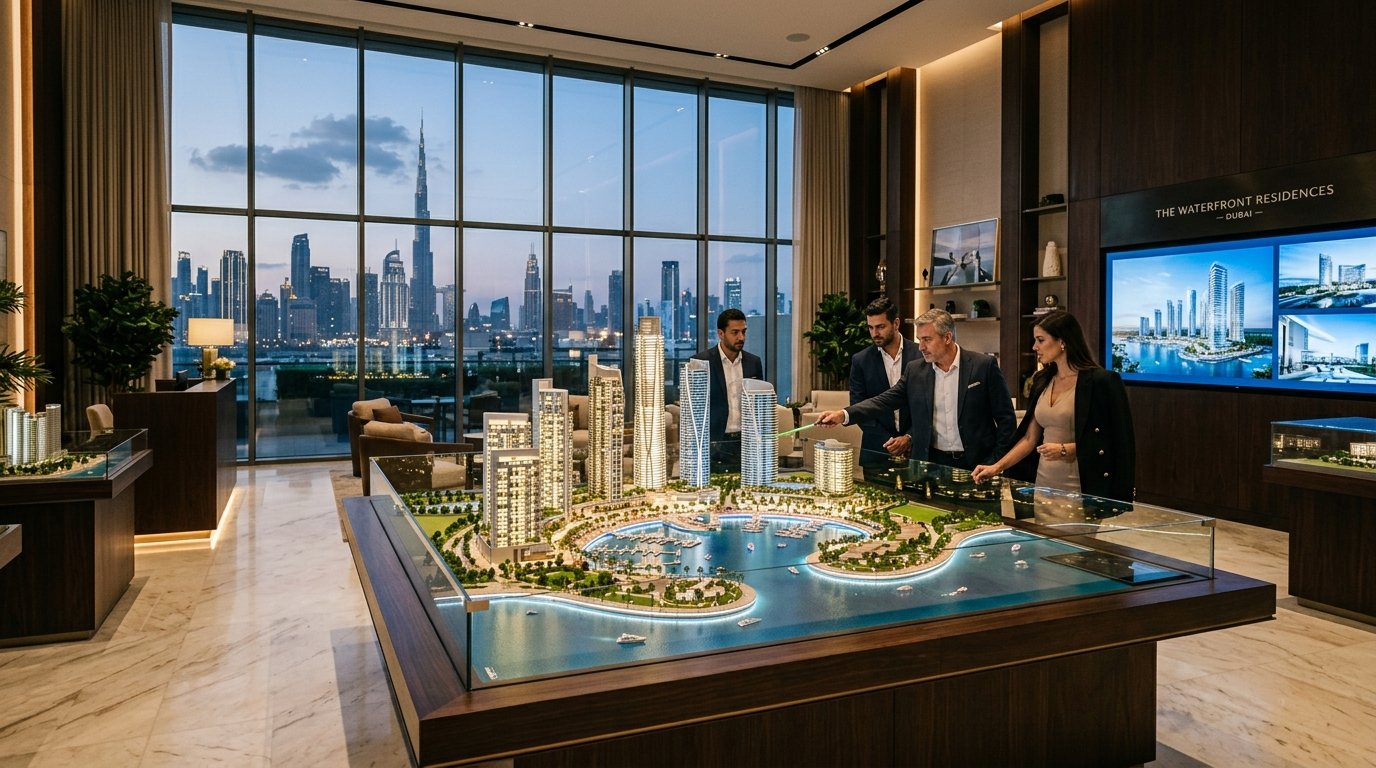
Off-plan real estate represents the undisputed economic engine of Dubai’s property boom, accounting for more than 62% of all residential transactions recorded by the Dubai Land Department. For global investors, family offices, and individual wealth builders, purchasing property directly from master developers prior to construction completion offers an unbeatable combination of staggered capital outlays, below-market entry pricing, and substantial capital appreciation accrued throughout the multi-year development cycle. Yet the unprecedented global confidence fueling Dubai’s off-plan sector is not merely a product of architectural brilliance; it is anchored in the world’s most rigorous statutory consumer protection framework—spearheaded by the Real Estate Regulatory Agency (RERA), mandated project escrow accounts under Law No. 8 of 2007, and centralized Oqood pre-title registration.
Executive Overview: Why Off-Plan Real Estate Dominates Dubai’s Investment Landscape
Over the past three years, Dubai’s off-plan property sales have rewritten global real estate benchmarks. During 2024 and 2025, off-plan transaction volumes consistently outpaced secondary market resales, with annual off-plan capital allocations breaching AED 250 billion across more than 80,000 recorded contracts. Entering 2026, this momentum is supported by fundamental structural factors rather than speculative euphoria. The city’s rapidly expanding population—growing by over 100,000 residents annually under the visionary Dubai 2040 Urban Master Plan—has generated a chronic shortage of premium housing that secondary resale inventory simply cannot satisfy.
Master developers have responded by introducing master-planned communities centered around ecological wellness, crystal recreational lagoons, championship golf clubs, and autonomous transit infrastructure. However, for international buyers accustomed to Western development risks—where developer insolvencies or construction stalls can result in protracted litigation—understanding the statutory safeguards protecting investors in Dubai is vital. In this comprehensive handbook, the senior investment team at Vintage Luxe Real Estate breaks down the complete legal architecture, financial mechanics, developer selection criteria, and yield strategies governing Dubai off-plan real estate in 2026.
The Statutory Safeguard: Law No. 8 of 2007 (Escrow Account Law) Examined
The bedrock upon which Dubai’s off-plan market rests is Law No. 8 of 2007 Concerning Escrow Accounts for Real Estate Development in the Emirate of Dubai. Enacted to permanently eliminate the risk of speculative developer malfeasance, Law No. 8 establishes strict criminal and financial penalties for unauthorized fund handling, creating a completely ring-fenced financial ecosystem:
1. Ring-Fenced Project-Specific Escrow Accounts
Under Law No. 8, every developer seeking to sell off-plan units must establish a dedicated, project-specific Escrow Account with an accredited UAE financial institution approved by the Dubai Land Department. A developer cannot pool funds across multiple developments or divert capital from Project A to finance Project B. Every single dirham paid by an investor—whether booking deposits, milestone installments, or administrative charges—must be deposited directly into that specific project’s escrow account.
2. 20% Construction Performance Guarantees
Before RERA grants a developer the statutory license to commence marketing or accept a single dirham of customer money, the developer must prove significant financial commitment. The developer must either:
- Own 100% of the project development land completely unencumbered; and
- Physically complete at least 20% of on-site construction works verified by government inspectors; OR
- Deposit a 20% cash bank guarantee into the project escrow account to guarantee project viability.
3. Engineering Milestone-Based Fund Releases
Developers cannot withdraw funds from the escrow account at will. Capital is disbursed to contractors and project managers in strict tranches that correspond directly to physical construction milestones certified by independent, government-appointed engineering auditors who physically inspect the building site. For instance, funds earmarked for structural completion are only released once the certified auditor confirms that the superstructure has reached its statutory height milestone. If construction pauses, fund disbursements freeze automatically.
4. The 5% Post-Handover Retention Fund
To ensure developers do not abandon buildings immediately upon key handover, RERA mandates that 5% of the total project value remains locked in the escrow account for one full year following the issuance of the Building Completion Certificate (BCC). This statutory retention reserve guarantees that any latent defects, architectural snags, or MEP warranty issues identified by homeowners during the first year of occupancy will be rectified at the developer’s expense.
Statutory Default Protections: Executive Council Resolution No. 6 of 2010
A critical legal pillar that distinguishes Dubai from less regulated jurisdictions is the comprehensive statutory framework governing contract default, project cancellations, and dispute resolutions under Executive Council Resolution No. 6 of 2010 Approving the Executive Regulations of Law No. 13 of 2008:
1. Statutory Protections if a Developer Defaults
If a master developer experiences catastrophic delays or fails to proceed with construction without legitimate justification approved by RERA, the Dubai Land Department possesses sweeping powers under Article 11 of Law No. 13. RERA can formally cancel the project registration, appoint a replacement judicial master developer, or transfer the project to the Special Judicial Committee for the Liquidation of Cancelled Real Estate Projects. In the event of liquidation, the escrow bank account funds are distributed directly back to registered buyers with statutory priority over general commercial creditors.
2. Balanced Protections if a Buyer Defaults
Conversely, if a purchaser defaults on contractual milestone payments, developers cannot arbitrarily confiscate all invested capital. The law establishes an equitable, tiered forfeiture scale linked directly to physical construction progress certified by RERA:
- Under 60% Construction Completion: If the developer has completed less than 60% of construction, the maximum penalty the developer may deduct upon contract termination is 25% of the total purchase price, returning the entire remaining balance to the buyer.
- Between 60% and 80% Construction Completion: The maximum allowable deduction is capped at 40% of the total purchase price, with the remainder refunded to the purchaser.
- Above 80% Construction Completion: The developer may either retain up to 40% of the purchase price and cancel the contract, demand performance through the courts, or auction the property through the Dubai Land Department to recover unpaid balances.
- Mandatory 30-Day DLD Notice: Before initiating any contract termination, the developer must submit a formal petition through the DLD, which serves an official 30-day legal notice to the buyer via certified postal channels and email to allow rectification of arrears.
The Role of Oqood: Pre-Title Registration & Ownership Protection
In many emerging property markets, purchasing an off-plan property confers only an unsecured contractual promise between buyer and developer. In Dubai, off-plan ownership is formally recognized as a registered property right under the Oqood Pre-Registration System, established pursuant to Law No. 13 of 2008 Regulating the Interim Real Estate Register in the Emirate of Dubai:
1. Legal Protection of Equitable Title
Within 30 to 60 days of executing the Sales and Purchase Agreement (SPA) and paying the 4% DLD transfer fee, the developer must submit the contract to the Dubai Land Department for Oqood registration. The DLD issues an official Oqood Certificate containing a unique digital registry number, cadastral map reference, unit number, floor level, and registered purchase price. This document legally establishes the buyer’s equitable ownership on the government’s centralized land registry.
2. Elimination of Double-Selling Risks
Because the unit is locked on the government’s blockchain-authenticated Oqood registry, a developer cannot legally sell, mortgage, or transfer that specific property to any third party. Any attempted transaction without the registered buyer’s formal consent is void ab initio under UAE federal law.
3. Seamless Conversion to Permanent Title Deed
Upon physical completion of the project, final building inspection, and settlement of any remaining handover balances, the Dubai Land Department automatically converts the interim Oqood certificate into an unencumbered, permanent electronic Title Deed without requiring new transfer taxes or renegotiations.
The Anatomy of Modern Developer Payment Plans in 2026
The primary financial catalyst attracting international capital to Dubai off-plan real estate is the structure of developer payment schedules. Unlike traditional mortgage acquisitions that require large lump-sum cash equity and immediate interest repayments, off-plan payment plans provide interest-free capital flexibility:
1. Standard Construction-Linked Payment Plans (e.g., 60/40, 70/30, 80/20)
The most common payment structure among premier master developers (such as Emaar, Sobha, and Nakheel) links installments directly to project milestones:
- Booking / Down Payment: 10% to 20% paid at reservation, accompanied by the 4% DLD fee.
- During Construction: 40% to 60% divided into predictable quarterly or bi-annual installments (e.g., 10% every 5 to 6 months) spanning the 3 to 4-year construction window.
- At Final Handover: 20% to 40% due upon 100% completion and key handover. Investors frequently finance this final handover tranche through a commercial bank mortgage, having already funded the initial equity during construction.
2. Post-Handover Payment Plans (PHPP)
Pioneered by innovative developers like Danube, Binghatti, and Tiger Properties, post-handover payment plans allow investors to pay a portion of the purchase price (typically 20% to 40%) after taking physical possession of the property:
- The 1% Monthly Plan: Investors pay 10% down payment, followed by 1% monthly installments during construction, and continue paying 1% per month for 24 to 36 months post-handover.
- Self-Funding Mechanics: Once the building is completed and handed over, the investor immediately leases the residence on the open market. The rental income generated from the tenant effectively funds or significantly offsets the remaining 1% monthly developer payments, creating a virtually self-amortizing asset.
3. 50/50 Handover Plans
Favored by conservative institutional investors, 50/50 plans require 50% paid in small staggered installments during construction, with the remaining 50% due strictly upon completion. This minimizes committed capital until the physical asset is delivered.
Macro Catalysts: Dubai 2040 Master Plan & Metro Blue Line Expansion
Off-plan capital appreciation is heavily correlated with state-funded infrastructure execution. Investors who position capital in corridors slated for multi-billion-dirham transit and urban upgrades capture exponential capital growth:
1. The AED 18 Billion Dubai Metro Blue Line
Scheduled to become operational across 2029, the Dubai Metro Blue Line spans 30 kilometers across 14 stations, directly linking Dubai International Airport (DXB) with key high-growth master communities including Dubai Creek Harbour, Dubai Silicon Oasis, International City, and Ras Al Khor. Historical transport data in Dubai reveals that residential properties situated within a 10-minute walk of an operational Metro station command a 15% to 22% rental yield premium and 28% higher capital appreciation relative to transit-isolated developments.
2. Al Maktoum International Airport (DWC) Expansion
The landmark announcement of the AED 128 billion passenger terminal expansion at DWC will create the largest airport in the world, capable of handling 260 million passengers annually. Over the coming decade, all commercial operations from DXB will transition to DWC. This monumental shift has catalyzed massive off-plan master developments across Dubai South, Expo City, and Palm Jebel Ali, establishing the southern corridor as the most lucrative generational land bank in the emirate.
Financial Engineering: Capital Appreciation During Construction
Understanding the mathematical mechanism of off-plan equity multiplication explains why institutional wealth managers allocate heavily to Dubai developments. Off-plan real estate offers built-in financial leverage without bank debt:
Consider an investor acquiring an off-plan 2-bedroom luxury apartment at VIP launch phase for AED 2,000,000 on a 60/40 payment plan over a 3-year construction timeline:
- Year 0 (Launch): Investor commits 20% down payment = AED 400,000 (+ AED 80,000 DLD fee). Total cash deployed: AED 480,000.
- Year 1: Investor pays 20% in milestone installments = AED 400,000. Total cash deployed: AED 880,000.
- Year 2: Investor pays 20% in milestone installments = AED 400,000. Total cash deployed: AED 1,280,000.
- Year 3 (Completion & Handover): As the master community infrastructure matures (retail pavilions, golf courses, parks open) and secondary market demand surges, prime Dubai developments historically appreciate by 25% to 35% above launch pricing. The property is now valued at AED 2,600,000.
- Final Equity Settlement: The investor settles the final 40% handover balance (AED 800,000) through cash or mortgage. Total purchase price paid: AED 2,000,000.
- Net Capital Gain: AED 600,000 paper equity gain on an initial asset price of AED 2M. Measured against the staggered cash outlay, the cash-on-cash Return on Investment (ROI) often exceeds 45% to 60% before rental dividends even commence.

The Assignment Strategy: How to Resell (Flip) Off-Plan Contracts Before Completion
Many international investors enter off-plan contracts with the deliberate strategy of reselling the contract—known legally as a Property Assignment—prior to building completion, capturing equity gains without ever funding the final handover balance. In Dubai, this process is strictly regulated to maintain market integrity:
1. Minimum Paid Equity Thresholds
Under developer guidelines approved by the Dubai Land Department, an original buyer cannot legally assign or resell an off-plan contract immediately after paying a 10% booking deposit. Developers impose a mandatory minimum paid equity threshold—customarily 30% to 40% of the total purchase price. Once the original buyer has remitted this threshold to the project escrow account, the developer issues authorization for open resale.
2. Developer No Objection Certificate (NOC) for Resale
The seller (original buyer) and incoming secondary buyer execute a formal Contract F / Assignment Agreement. Both parties apply to the master developer for an official Resale NOC. The developer verifies that all scheduled construction installments are paid to date, assesses an administrative NOC processing fee (typically AED 3,000 to AED 5,000 + VAT), and issues the certificate.
3. Settlement and Oqood Re-Assignment
The parties attend a DLD Registration Trustee office. The incoming buyer reimburses the seller for all capital installments paid to the developer to date, plus the agreed capital premium (profit). The incoming buyer settles the standard 4% DLD transfer fee on the original or revised price. The Dubai Land Department re-assigns the Oqood certificate into the incoming buyer’s name, and the new buyer assumes responsibility for all remaining scheduled milestone payments to the developer.
Developer Selection: Track Records, Balance Sheets & Delivery Ratings
The single most critical variable governing off-plan investment success is developer execution. In Dubai, master developers possess vastly different operational models, finishing standards, and delivery track records. At Vintage Luxe, we categorize developers into three primary institutional tiers:
Tier 1: Government-Backed Sovereign Master Developers
- EMAAR Properties: The undisputed blue-chip titan of the Middle East, with a market capitalization exceeding AED 70 billion. Emaar master-develops self-contained cities, delivering unmatched community governance, lush green landscaping, and resilient resale liquidity. Handover delay risk is virtually nonexistent. Explore exclusive Emaar developments.
- NAKHEEL: Dubai’s master waterfront architect, backed by the Dubai Government. Nakheel is the sole visionary behind Palm Jumeirah, Palm Jebel Ali, and Dubai Islands. Investing in Nakheel off-plan waterfront projects grants entry to scarce coastal land with exponential multi-year upside. View Nakheel waterfront launches.
Tier 2: Private Ultra-Luxury & Craftsmanship Leaders
- SOBHA Realty: Renowned for its proprietary “backward integration” model, manufacturing all joinery, aluminum facades, glazing, and MEP components in-house. Sobha delivers the absolute highest standard of interior craftsmanship and acoustic insulation in the UAE. Discover Sobha Realty master residences.
- BINGHATTI Developers: Hyper-agile luxury creator leading the world in branded residences (Bugatti, Mercedes-Benz, Jacob & Co). Binghatti is renowned for blistering construction velocities, often completing major towers 6 to 12 months ahead of statutory schedule. Explore Binghatti branded towers.
- ELLINGTON Properties: Boutique design-led developer catering to aesthetic connoisseurs, focusing on resort-style amenities, artisanal lobby designs, and boutique low-density communities across Downtown, Palm Jumeirah, and JVC.
- DAMAC Properties: Large-scale luxury developer pioneering iconic co-branded towers (Cavalli, de GRISOGONO) and massive master communities like DAMAC Hills, DAMAC Hills 2, and DAMAC Lagoons.
- Prestige One Developments: Emerging luxury boutique developer emphasizing biophilic architecture, sustainable engineering, and prime urban locations. Learn about Prestige One projects.
Comparative Data Table: Dubai Off-Plan Hotspots in 2026
To assist your capital allocation, our research desk has analyzed transactional performance benchmarks across Dubai’s most active off-plan master developments:
| Development / Master Community | Master Developer | Typical Price / Sq. Ft. (AED) | Standard Payment Plan | Target Handover Window | Projected Appreciation (Launch to Handover) |
|---|---|---|---|---|---|
| Palm Jebel Ali | Nakheel | AED 3,200 – 5,500 | 80/20 | 2027 – 2029 | +35% to +50% |
| Dubai Creek Harbour | Emaar Properties | AED 1,850 – 2,600 | 80/20 / 70/30 | 2026 – 2028 | +25% to +35% |
| Dubai South (Aerotropolis / Expo City) | Dubai South / Emaar / Damac | AED 1,050 – 1,450 | 60/40 / PHPP | 2026 – 2028 | +30% to +45% |
| Sobha Hartland II (MBR City) | Sobha Realty | AED 2,200 – 3,200 | 60/40 / 70/30 | 2027 – 2028 | +25% to +35% |
| Dubai Islands | Nakheel | AED 2,100 – 3,400 | 80/20 | 2026 – 2028 | +30% to +40% |
| Business Bay Canal Corridor | Binghatti / Omniyat / Damac | AED 2,200 – 4,000 | 70/30 / 60/40 | 2026 – 2027 | +20% to +30% |
| Tilal Al Ghaf | Majid Al Futtaim | AED 1,950 – 3,500 | 60/40 / 50/50 | 2026 – 2027 | +30% to +45% |
| Jumeirah Village Circle (JVC) | Danube / Binghatti / Ellington | AED 1,150 – 1,550 | 1% Monthly / PHPP | 2026 – 2027 | +18% to +28% |
The 12-Point Investor Due Diligence Checklist for Off-Plan Buyers
Before transferring booking funds or signing developer reservation documents, our conveyancing desk at Vintage Luxe enforces this rigorous diligence checklist:
- DLD Project Registration: Verify the development is registered with RERA via the Dubai REST application.
- Escrow Account Authentication: Confirm the official escrow bank name and trust account IBAN against DLD records. Never transfer funds to personal or corporate operating accounts.
- Land Title Status: Confirm the master developer owns the development plot unencumbered, or that required RERA bank guarantees are lodged.
- Certified Construction Progress: Review the most recent government inspection percentage on the DLD portal to verify physical momentum.
- Developer Delivery History: Audit the developer’s historical portfolio for on-time delivery percentages and post-handover finishing quality.
- Contractual Completion Date & Grace Period: Clarify the anticipated completion date and statutory grace periods in the Sales and Purchase Agreement (SPA).
- Service Charge Projections: Request estimated initial Mollak service charges per square foot to model realistic future net rental yields.
- Resale Assignment Criteria: Check the exact paid equity threshold required before the developer grants resale NOC permission (typically 30% to 40%).
- Post-Handover Snagging Rights: Ensure the SPA confirms the 1-year defects liability period and 10-year decennial structural warranty under Article 880 of the UAE Civil Code.
- Parking and Storage Allocation: Confirm that designated basement parking bays and storage units are explicitly enumerated in the contract schedule.
- Floorplan & Balcony Specifications: Check internal suite area versus external balcony square footage to verify net usable living space.
- Master Community Infrastructure: Verify the completion timeline for external access roads, metro links, schools, and retail parks surrounding the building.
Snagging, Building Handover & Statutory Warranties
When an off-plan building nears completion, the transition from construction site to delivered home requires formal due diligence. The Dubai Land Department and UAE Civil Code provide clear legal protections for buyers during this phase:
1. The Building Completion Certificate (BCC)
A developer cannot issue a notice of completion or demand final handover installments until Dubai Municipality, Civil Defence, and relevant utility authorities inspect the structure and issue an official Building Completion Certificate (BCC). This certifies that fire life-safety systems, elevators, structural loads, and electrical infrastructure comply fully with municipal building codes.
2. Professional Snagging Inspections
Upon receiving the handover invitation, the investor conducts a comprehensive snagging inspection. At Vintage Luxe, we coordinate with certified third-party snagging engineers who utilize thermal imaging, moisture meters, socket testers, and acoustic gauges to generate an exhaustive snagging audit. The developer is legally obligated to rectify all identified aesthetic, electrical, and plumbing defects before final acceptance.
3. Statutory 10-Year Decennial Warranty
Under Article 880 of the UAE Civil Code, developers and contractors are held strictly liable under a 10-Year Decennial Liability Warranty for any total or partial structural collapse, foundation failure, or major structural defect threatening building stability. This statutory liability cannot be waived or contractually excluded.
4. One-Year Comprehensive Defects Liability Period (DLP)
In addition to structural guarantees, developers must provide a comprehensive 1-year warranty covering mechanical, electrical, plumbing (MEP), and fixture installations. Any failure of air conditioning units, water heaters, pumps, or appliances during the initial 12 months is rectified free of charge by the developer’s facilities management team.
Frequently Asked Questions: Buying Off-Plan in Dubai
What happens if a developer delays project completion?
Under RERA regulations and standard DLD Sales and Purchase Agreements, developers are granted a statutory grace period (customarily 6 to 12 months) to account for unforeseen supply chain or force majeure events. If delays exceed statutory allowances without RERA justification, buyers can petition the Dubai Courts or the Rental Dispute Center for contractual rescission and full escrow refunds under Executive Council Resolution No. 6 of 2010.
Can foreign non-residents buy off-plan properties?
Yes. Foreign non-residents have full legal rights to purchase off-plan freehold real estate in Dubai. Transactions can be completed 100% remotely with passport verification and electronic contract signatures.
Are off-plan payments eligible for the 10-Year UAE Golden Visa?
Yes. Off-plan properties with an Oqood purchase value of AED 2,000,000 or greater are eligible for the 10-Year Golden Visa once statutory developer payment thresholds (typically 20% to 50%) are met, supported by an official developer Statement of Account and DLD pre-approval.
How do I verify if a project’s escrow account is legitimate?
You can verify any active project in real time using the official Dubai REST mobile app or the DLD website. Enter the project name or developer registration number to view the certified escrow bank name, escrow account number, and percentage of physical construction verified by government auditors.
Do I have to pay agent commission fees when buying off-plan?
No. When purchasing an off-plan property directly from a master developer through an authorized agency like Vintage Luxe, there are zero brokerage commission fees payable by the buyer. Agency advisory fees are compensated directly by the master developer.
Can I get a mortgage for an off-plan property?
Yes. UAE commercial banks offer mortgages for off-plan properties once the development reaches a minimum 50% construction completion certified by RERA, allowing buyers to finance the remaining construction and handover tranches.
Access Exclusive VIP Off-Plan Allocations with Vintage Luxe Real Estate
Navigating Dubai’s fast-moving off-plan landscape requires insider market intelligence, direct developer relationships, and uncompromising legal due diligence. At Vintage Luxe Real Estate, our senior advisors maintain direct tier-1 allocations with Dubai’s premier master developers—including Emaar, Nakheel, Sobha, Binghatti, and Ellington.
We provide our private clients with early access to VIP pre-launch allocations, prime high-floor corner inventories, preferred milestone payment schedules, and comprehensive portfolio structuring. Protect your capital and maximize your returns with Dubai’s leading luxury real estate advisors.
Contact our off-plan investment desk at Vintage Luxe Real Estate or explore our upcoming Dubai luxury off-plan developments.



Comments are closed