





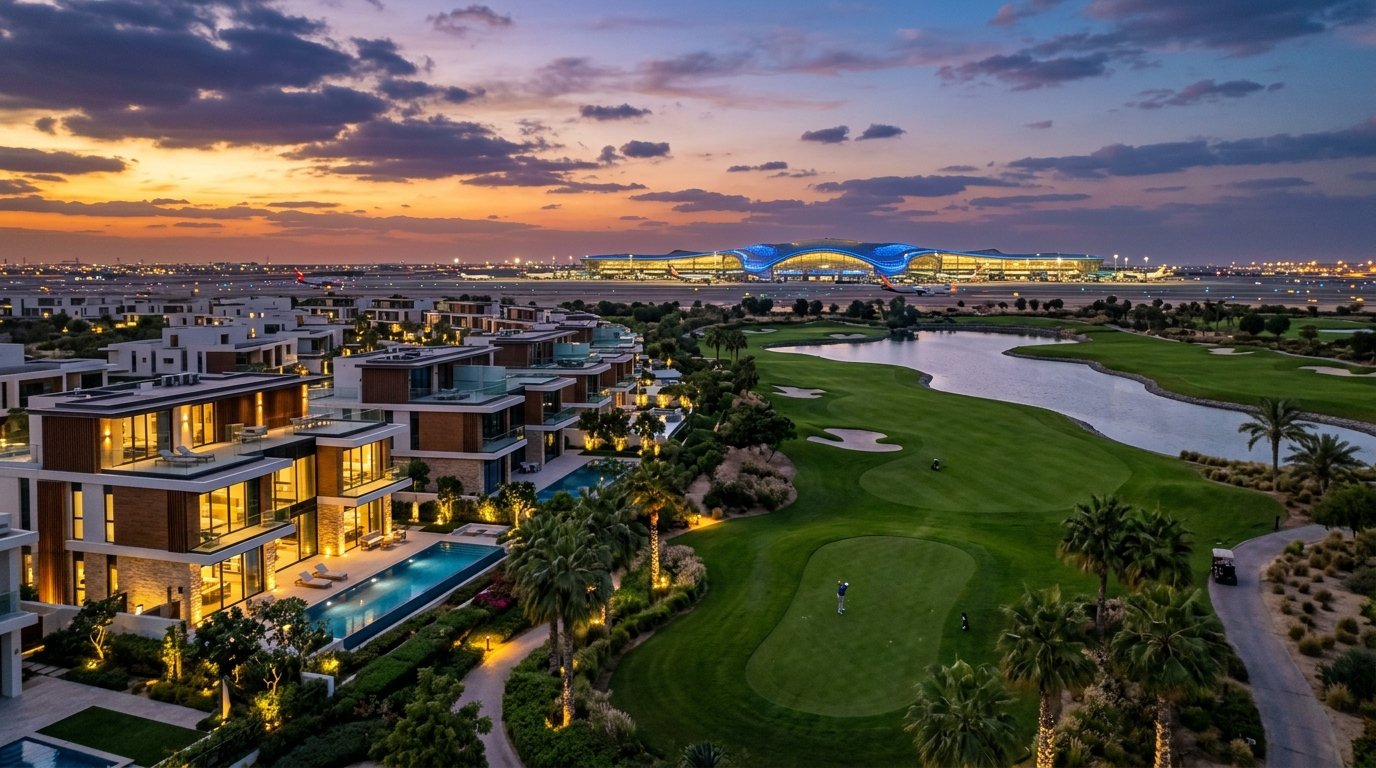
The formal ratification of the AED 128 billion ($35 billion) passenger terminal expansion at Al Maktoum International Airport (DWC) represents the most monumental economic and urban development pivot in Dubai’s history. Sanctioned by His Highness Sheikh Mohammed bin Rashid Al Maktoum, Vice President and Prime Minister of the UAE and Ruler of Dubai, this colossal megaproject will construct the world’s largest airport—an aviation colossus encompassing five parallel runways, 400 aircraft gates, and an unprecedented capacity to process 260 million passengers annually. Over the coming decade, all commercial passenger and cargo operations currently hosted at Dubai International Airport (DXB) will fully transition to DWC, permanently relocating the economic center of gravity of the emirate southward. For global real estate investors, sovereign wealth funds, and private wealth managers, this transition triggers an unprecedented housing demand shock across Dubai South, Emaar South, and Expo City, creating a multi-decade wealth creation corridor unmatched across global property markets.
The Aerotropolis Phenomenon: Redefining Dubai’s Economic Geography
In classical urban economics, cities historically constructed airports on their remote suburban peripheries to manage acoustic noise and airspace constraints. However, as established by urban theorist Dr. John Kasarda, 21st-century economic globalization has inverted this paradigm through the concept of the Aerotropolis: a dynamic urban airport city where infrastructure, corporate headquarters, advanced logistics, and residential communities are master-planned directly around high-speed aviation hubs. Time and global connectivity replace physical land proximity as the primary metrics of commercial value.
Al Maktoum International Airport is not merely a transport terminal; it is the nucleus of a 145-square-kilometer smart city designated as Dubai South. When operating at peak scale, DWC will be five times the size of today’s DXB, handling a volume of air travelers equivalent to the combined populations of the United Kingdom, France, Germany, and Italy. According to official government projections, the airport and its surrounding aviation, logistics, and commercial freezones will generate over 500,000 direct and indirect specialized jobs, necessitating the rapid construction of high-quality housing for an incoming population exceeding one million permanent residents.
Master Communities in the Direct DWC Impact Zone
The capital expenditure unleashed by the DWC expansion directly impacts several distinct master-planned communities situated within a 5-to-15-minute transit radius of the new passenger terminals. Each sub-market offers a differentiated product typology, pricing point, and investment thesis.
1. Dubai South Residential District
The Dubai South Residential District is the primary high-density urban living zone directly adjacent to the airport’s northern perimeter. Master-planned as a 15-minute walkable city, the district incorporates mixed-use apartment communities, community parks, British-curriculum schools, and retail boulevards.
Prominent sub-developments—including The Pulse, South Bay, and Sakany—cater directly to mid-to-senior aviation professionals, ground operations supervisors, air traffic controllers, and corporate logistics personnel. Mid-rise apartments currently trade between AED 850 and AED 1,150 per square foot, generating outstanding gross rental yields of 8.8% to 10.4%. With occupancy rates across delivered buildings consistently exceeding 96%, buy-to-let investors in the Residential District benefit from virtually zero vacancy risk and predictable rental collection cycles.
2. Emaar South: Master-Planned Luxury Golf Community
Developed as a premier joint venture between Emaar Properties and Dubai South, Emaar South represents the suburban luxury sanctuary of the aerotropolis. Spanning 145 hectares, Emaar South is anchored by a magnificent 18-hole championship golf course, clubhouse dining, extensive linear parks, and prestigious gated villa enclaves.
Sub-communities including Golf Verge, Fairway Villas, Greenview, and Expo Golf Villas deliver three-to-five-bedroom contemporary townhouses and detached luxury villas. This community is the primary residential choice for airline captains, senior Emirates Airline executives, multinational engineering directors, and affluent expatriate families seeking low-density greenery with immediate highway access. Townhouse prices currently range from AED 2.2 million to AED 4.2 million, with standalone golf villas trading between AED 4.5 million and AED 7.5 million. Driven by the brand prestige of Emaar and severe regional shortages of quality family villas, capital values in Emaar South are forecasted to appreciate by 38% to 48% over the 2026–2030 cycle.
3. Expo City Dubai: Innovation Freezone & Sustainable Smart City
Repurposing the historic site of Expo 2020 and COP28, Expo City Dubai has evolved into a forward-looking innovation, clean-tech, and commercial hub. It serves as the global or regional headquarters for major multinational corporations, including Siemens Energy, Terminus AI, and DP World.
Residential offerings within Expo City—such as Expo Valley (featuring luxury eco-villas and townhouses integrated into a natural wadi landscape) and Mangrove Residences—command a distinct sustainability premium. Properties here trade at AED 1,600 to AED 2,200 per square foot, appealing to eco-conscious corporate executives, tech entrepreneurs, and international institutional funds seeking LEED-certified and Net-Zero energy residential assets.
4. The Oasis by Emaar & The Palm Jebel Ali Corridor
The economic ripple effect of DWC extends directly into Dubai’s ultra-prime luxury market. Master developments such as The Oasis by Emaar (a $20 billion luxury lagoon sanctuary) and Palm Jebel Ali (located just 15 minutes west along the coast) capture the ultra-high-net-worth capital generated by the aerotropolis. Billionaire logistics magnates, aircraft leasing executives, and global industrial owners operating out of DWC’s Mohammed Bin Rashid Aerospace Hub (MBRAH) will reside in trophy beachfront or private lagoon mega-estates within effortless commuting distance of their private jets.
Architectural Deep-Dive: Emaar South’s Signature Residential Sub-Enclaves
To fully capitalize on Emaar South’s capital appreciation curve, investors must understand the specific micro-communities developed across the 145-hectare masterplan. Emaar has phased development across four distinct product categories designed to capture diverse executive tenant profiles:
1. Fairway Villas (Phases 1, 2 & 3)
Fairway Villas represent the premier standalone luxury residential offering within Emaar South. Situated along the expansive perimeter of the 18-hole championship golf course, these four- and five-bedroom detached residences feature built-up areas ranging from 3,800 to 4,800 square feet on generous plots spanning 5,500 to 7,200 square feet. Floor plans incorporate double-height living areas, floor-to-ceiling thermal acoustic glazing with views across the rolling greens, private landscaped gardens with swimming pool provisions, maid’s quarters, and dedicated rooftop terraces. Delivered to institutional finish standards, Fairway Villas trade between AED 4.8 million and AED 7.5 million, commanding premium long-term corporate leases from senior aviation directors.
2. Golf Verge Luxury Apartments
Catering to single aviation professionals, corporate consultants, and tech personnel, Golf Verge introduces mid-rise, contemporary resort-style apartment living to the golf course fairway edge. Featuring one-, two-, and three-bedroom luxury residences ranging from 720 to 1,650 square feet, Golf Verge units feature expansive open-plan European kitchens, private balconies with golf course panoramic vistas, an infinity-edge swimming pool deck, state-of-the-art gymnasium facilities, and co-working executive lounges. With purchase prices starting from AED 850,000 for one-bedroom apartments, Golf Verge offers investors entry-level equity requirements with projected gross rental yields of 8.8% to 9.5%.
3. Expo Golf Villas (Phases 1 through 6 – Parkside)
Expo Golf Villas (also marketed as Parkside) represents one of the most successful master-planned townhouse launches in Dubai’s real estate history. Phased across six dedicated clusters surrounding linear community parks and community retail centers, these three- and four-bedroom modern townhouses offer built-up areas ranging from 1,850 to 2,450 square feet. Originally launched by Emaar at an accessible baseline of AED 999,999 to AED 1.4 million between 2018 and 2021, these homes have experienced monumental appreciation, trading in 2026 between AED 2.2 million and AED 3.2 million on the secondary market—an extraordinary 120%+ capital appreciation performance that validates the long-term investment thesis of the Dubai South corridor.
4. Urbana Stacked Townhouses & Greenview
Urbana delivers an innovative two-tiered stacked townhouse typology comprising tiered ground-floor two-bedroom garden residences and first-floor two-to-three-bedroom sky terrace units. Offering exceptional affordability (priced from AED 1.2M to AED 1.7M), Urbana captures robust, uninterrupted tenant demand from airline cabin crew and airport ground supervisors who seek high-quality gated community living with swimming pools, tennis courts, and retail amenities at economical rental price points.
Dubai South Corridor Real Estate Investment Matrix (2026–2030 Forecast)
The comparative matrix below details current price levels, projected capital appreciation, rental yield benchmarks, and transit metrics across the key sub-markets surrounding Al Maktoum International Airport:
| Community Node | Primary Asset Typology | Current Avg Price/Sq Ft | 2026–2030 Capital Growth Forecast | Projected Gross Rental Yield | Commute Time to DWC Terminal | Target Tenant Demographic |
|---|---|---|---|---|---|---|
| Dubai South Residential | Studios, 1 & 2-Bed Apts | AED 880 – 1,120 | +42.0% to +52.0% | 9.2% – 10.5% | 5 – 7 mins | Cabin Crew, Ground Staff, Logistics |
| Emaar South (Townhouses) | 3 & 4-Bed Townhouses | AED 1,150 – 1,380 | +36.0% to +45.0% | 7.8% – 8.6% | 7 – 10 mins | Airline Pilots, Corporate Managers |
| Emaar South (Golf Villas) | 4 & 5-Bed Golf Mansions | AED 1,450 – 1,850 | +38.0% to +48.0% | 7.2% – 7.9% | 8 – 10 mins | Senior Aviation Directors, HNWIs |
| Expo City (Expo Valley) | Eco-Villas & Townhouses | AED 1,650 – 2,100 | +30.0% to +38.0% | 6.8% – 7.5% | 10 – 12 mins | Tech Executives, Green Innovators |
| South Bay (Lagoon Villas) | Waterfront Mansions & Townhouses | AED 1,200 – 1,550 | +35.0% to +44.0% | 7.5% – 8.3% | 6 – 8 mins | Affluent Expat Families, Business Owners |
| Azizi Venice (Dubai South) | Lagoon-Front Apartments & Villas | AED 1,100 – 1,400 | +34.0% to +42.0% | 8.2% – 9.1% | 8 – 10 mins | Short-Term Tourists, Corporate Transits |
The 1-Million Resident Housing Deficit: Supply vs. Demand Analysis
To quantify the extraordinary capital growth potential of Dubai South, investors must examine the mathematical imbalance between incoming population demand and physical residential delivery capacity. Real estate markets move on scarcity, and the aerotropolis is entering an acute structural supply deficit.
As Emirates Airline, flydubai, dnata, and over 150 international carriers progressively shift their entire fleets, maintenance hubs, flight training academies, and catering divisions from DXB to DWC between 2026 and 2034, over 120,000 aviation professionals must physically relocate their residences to the southern corridor. When factoring in the multiplier effect of secondary commercial services, education, healthcare, and retail personnel, the Dubai South master zone requires an estimated 25,000 to 30,000 new residential units annually over the next decade.
However, comprehensive construction auditing across all master developers in Dubai South reveals an average delivery pipeline of only 8,500 to 12,000 units per year through 2028. This structural shortfall of over 15,000 units annually guarantees intense tenant bidding wars, high renewal retention rates, and sustained upward pressure on residential rents, protecting investors against downside market volatility.
Rental Yields & Cash Flow Dynamics: Aviation Leases vs. Transit Short-Term Rentals
The operational cash flow profile in Dubai South provides compelling flexibility across two distinct monetization strategies:
1. Corporate & Airline Staff Annual Ejari Leases
Emirates Airline and international aviation conglomerates provide their flight crew and management personnel with dedicated housing allowances or execute direct master-lease agreements with residential building owners. Investors holding clusters of studio, one-bedroom, and two-bedroom apartments can secure institutional multi-year corporate leases with guaranteed rental payments deposited in 1 to 2 cheques annually. Net yields under this model consistently achieve 8.5% to 9.8% with zero management friction or turnover costs.
2. Short-Term Transit Layover Holiday Homes (DTCM)
With 260 million passengers projected to pass through DWC annually, short-term layover tourism will experience exponential growth. Tens of thousands of global international travelers with 12-to-36-hour flight layovers will choose to stay in fully furnished, high-amenity apartments in Dubai South or lagoon communities rather than booking conventional airport hotel rooms. Fully licensed holiday homes operated under DTCM regulations are projected to generate daily room rates ranging from AED 380 to AED 750, delivering annualized net yields of 10.5% to 12.2% for strategically positioned studio and one-bedroom units.
Financial Modeling Case Study: 5-Year Capital Staging & Net IRR Projections
To demonstrate the concrete wealth generation mechanics of the DWC aerotropolis, Vintage Luxe Real Estate has modeled two contrasting institutional investment scenarios across a 5-year investment holding period (2025 entry to 2030 stabilization):
| Financial Parameter | Strategy A: 3x 1-Bed Apartments (Dubai South) | Strategy B: 1x 4-Bed Fairway Villa (Emaar South) |
|---|---|---|
| Total Acquisition Value | AED 2,700,000 (AED 900,000 each) | AED 5,200,000 |
| DLD 4% Transfer + Admin Fees | AED 118,500 | AED 218,000 |
| Construction Equity Staged (2025–2028) | 70% = AED 1,890,000 | 80% = AED 4,160,000 |
| Final Handover Balance Due | 30% = AED 810,000 | 20% = AED 1,040,000 |
| Stabilized Annual Gross Rental Income (2028–2030) | AED 256,500 / year (9.5% gross yield) | AED 390,000 / year (7.5% gross yield) |
| Estimated Service Charges & Management | AED 32,400 / year (AED 15/sq ft) | AED 28,500 / year (AED 6/sq ft) |
| Cumulative Net Rental Yield Collected (2 Years) | AED 448,200 | AED 723,000 |
| Projected 2030 Exit Asset Valuation | AED 4,050,000 (+50.0% capital gain) | AED 7,540,000 (+45.0% capital gain) |
| Total Net Profit (Rental + Capital Appreciation) | AED 1,679,700 | AED 2,845,000 |
| Annualized Internal Rate of Return (IRR) | 18.4% Net Annualized IRR | 16.8% Net Annualized IRR |
Infrastructure Corridors: Rail, Highway, and Air Connectivity
The success of the DWC aerotropolis is underpinned by an unprecedented federal commitment to multi-modal transportation infrastructure, integrating road, heavy rail, metro, and air mobility:
- Dubai Metro Red & Blue Line Extensions: RTA plans will extend the existing Red Line (from Expo City station) directly into the central passenger concourses of DWC. Concurrently, southern extensions connecting the Blue Line alignment will facilitate seamless 35-minute rail transit between DWC and Dubai International Airport (DXB) during the operational transition phase.
- Etihad Rail Passenger & Freight Terminals: DWC integrates a massive station on the national Etihad Rail passenger and freight network. Business travelers will reach Abu Dhabi’s city center in 25 minutes and Al Ain in 30 minutes, converting Dubai South into the tri-city transit gateway of the UAE.
- Arterial Highway Super-Corridors: Dubai South is enveloped by four of the UAE’s most vital logistical arteries: Sheikh Mohammed Bin Zayed Road (E311), Emirates Road (E611), Expo Road (E77), and the newly expanded Al Yalayis Street (D57), providing barrier-free heavy transport and personal commuting access across all seven emirates.
- Commercial Flying Taxi Vertiports: The RTA and Joby Aviation have designated DWC as one of Dubai’s four inaugural commercial electric vertical take-off and landing (eVTOL) vertiport hubs, enabling executive passengers to fly from DWC to Palm Jumeirah in just 9 minutes.
The Commercial & Logistics Powerhouse: EZDubai & MBRAH
Beyond residential real estate, Dubai South houses the region’s most sophisticated industrial and logistics ecosystems, ensuring that real estate valuations are backed by tangible global economic commerce rather than retail speculation:
- Mohammed Bin Rashid Aerospace Hub (MBRAH): Dedicated to the global aerospace industry, MBRAH hosts private jet maintenance, repair, and overhaul (MRO) facilities, flight simulator centers, private VIP jet terminals, and aircraft completion centers serving Boeing, Airbus, Bombardier, and Gulfstream.
- EZDubai Dedicated E-Commerce Zone: A 920,000-square-meter purpose-built e-commerce district hosting regional fulfillment hubs for Amazon, Noon, DHL, and FedEx, capturing the exponential boom in cross-border GCC online retail trade.
- Dubai South Logistics District: Directly bonded to Jebel Ali Port via a dedicated customs-free sea-to-air transit corridor that transfers shipping containers from ship to cargo aircraft in under 4 hours—the fastest multimodal transit turnaround on Earth.
Off-Plan Launch Pipeline & Developer Payment Architectures
For investors deploying capital into off-plan developments across Dubai South and Emaar South in 2026, developer payment terms offer exceptional capital efficiency. Leading developers provide milestone schedules structured to minimize upfront capital commitments while maximizing return on equity (ROE):
- Emaar South Standard Structure (80/20): 10% booking deposit, 70% staged across certified construction milestones (typically 10% every 5–6 months), and a 20% final balance due upon handover in 2027/2028.
- Dubai South Master Developer Plans (70/30 & Post-Handover): Select projects in the Residential District and South Bay offer flexible payment plans requiring only 50% during construction and 50% spread over two to three years post-handover, allowing the property’s rental income to service the remaining capital installments.
- RERA Escrow Guarantee: In strict compliance with Dubai Law No. 8 of 2007, 100% of investor funds are held in project-specific escrow accounts audited by the DLD, with disbursements tied strictly to verified physical site progress.
The Strategic Investor Playbook: Capturing Alpha in Dubai South
To maximize portfolio returns across the DWC aerotropolis corridor, international capital allocators should adhere to the following tactical guidelines:
1. Divide Capital Between Cash-Flow Apartments and Capital-Growth Townhouses
An optimal portfolio allocation balances high immediate cash yields with long-term capital compounding. Allocate 60% of capital into studio and one-bedroom apartments in the Dubai South Residential District to lock in 9.5%+ gross rental yields, and deploy the remaining 40% into three-or-four-bedroom townhouses in Emaar South to capture 40%+ capital appreciation as executive family demand surges.
2. Focus on Master-Planned Infrastructure Integrators
Avoid standalone single-building developments situated on unpaved fringe plots. Prioritize integrated master communities developed by Tier-1 institutions (Emaar, Dubai South Government Master Developer) that feature dedicated schools, landscaped retail boulevards, public parks, and direct connections to planned metro stations.
3. Leverage the 2026–2028 Ground-Floor Entry Window
The market is currently in the initial awareness phase of the $35 billion expansion. By 2028, as the first phase of the mega-terminal takes physical structural form and international airlines commence flight schedule migrations, secondary market pricing will experience substantial upward re-ratings. Early entry in 2026 captures maximum infrastructure alpha.
Tax Optimization & Corporate Structuring for Dubai South Real Estate
As international fiscal scrutiny intensifies globally under OECD Pillar Two frameworks, global high-net-worth investors and family offices acquiring large residential or commercial portfolios in the Dubai South aerotropolis must structure their holdings with institutional precision. The UAE provides one of the world’s most advantageous, transparent, and compliant fiscal regimes, offering extraordinary wealth preservation benefits when properly leveraged:
- 0% Personal Income & Capital Gains Tax: Under Federal Decree-Law No. 47 of 2022 on the Taxation of Corporations and Businesses, income earned by natural persons (individual private investors) from personal freehold residential real estate investments, capital gains upon property disposal, and personal rental income remains completely exempt from UAE Corporate Tax (0% tax rate).
- Corporate Ownership via Freezone SPVs & Foundations: Institutional syndicates, private family offices, and foreign corporate funds can hold residential portfolios in Dubai South through private Special Purpose Vehicles (SPVs) or Foundations incorporated in the Dubai International Financial Centre (DIFC) or Abu Dhabi Global Market (ADGM). These structures enable unified multi-asset consolidation, streamlined conveyancing transfers, and comprehensive protection under English Common Law courts.
- Double Taxation Avoidance Treaties (DTTs): The UAE maintains active bilateral Double Taxation Agreements with over 140 nations worldwide—including the United Kingdom, Switzerland, France, Germany, Singapore, China, and India. International investors residing in high-tax jurisdictions can frequently offset or eliminate cross-border withholding taxes on dividend distributions originating from UAE real estate holding entities.
- Zero Inheritance and Forced Heirship Exemption: Non-Muslim international property owners can register official DIFC Wills or register assets under DIFC Foundations, guaranteeing complete testamentary freedom and direct generational succession without Sharia distribution mandates.
Secondary Market Liquidity & Strategic Exit Horizons (2026–2035)
Executing an institutional-grade investment in the aerotropolis corridor requires clear entry, holding, and divestment timelines. The 10-year development arc of Al Maktoum International Airport naturally delineates three strategic liquidity windows:
- Window 1: Pre-Operational Construction Arbitrage (2025–2028): Short-to-medium-term investors entering off-plan launches at early ground-floor pricing (e.g., Emaar South Fairway Villas or South Bay lagoon parcels) capture equity appreciation as construction reaches 70% to 80% completion. Investors can assign off-plan contracts on the secondary market prior to final handover, realizing 30% to 45% return on invested cash equity.
- Window 2: Operational Handover & Initial Cash Flow Stabilization (2028–2031): Long-term buy-to-let investors take physical handover of residential properties, furnish units to executive standards, and place them on multi-year corporate leases with relocating aviation conglomerates. Over this 3-year holding period, investors collect 8.5% to 10% annual net cash flow while passenger flight migrations accelerate.
- Window 3: Full Aerotropolis Maturity & Institutional Block Sale (2032–2035): As DXB operations complete their permanent migration to DWC and the airport reaches its 150-million+ passenger milestone, institutional REITs (Real Estate Investment Trusts), sovereign pension funds, and international asset managers will seek stabilized, cash-generating multi-family residential assets. Private investors holding multi-unit portfolios can execute lucrative block sales to institutional yield funds at compressed capitalization rates, achieving maximum terminal exit multiples.
Frequently Asked Questions (FAQ) About DWC Expansion & Dubai South
When will commercial flights officially move from DXB to Al Maktoum Airport (DWC)?
The transition is structured across a phased 10-year master timeline. The first phase of the new passenger terminal will be operational by approximately 2030, absorbing initial cargo, low-cost carriers, and select international airlines, with Emirates Airline and full hub operations fully shifting to DWC by the mid-2030s.
Are properties in Dubai South eligible for foreign 100% freehold ownership?
Yes. Dubai South and Emaar South are designated 100% foreign freehold zones. Foreign nationals of all citizenships can acquire full, unencumbered legal title deed ownership registered directly with the Dubai Land Department (DLD).
Does aircraft noise affect residential communities in Dubai South?
The masterplan of Dubai South was specifically engineered with vast buffer zones, acoustic orientation modeling, and strict flight path zoning. The primary residential districts (Residential District, Emaar South, and Expo City) are positioned laterally outside direct approach and departure flight corridors, ensuring peaceful living environments complying with international ICAO acoustic standards.
Can I qualify for the UAE Golden Visa by investing in Dubai South?
Yes. Any property acquisition—or combination of multiple property purchases—with a total aggregate value of AED 2,000,000 ($544,500) or higher in Dubai South qualifies the investor and their family for the prestigious 10-Year UAE Golden Visa, regardless of whether the property is ready, off-plan, or mortgaged.
What are the current average rental yields in Dubai South compared to Downtown Dubai?
Dubai South currently generates average gross rental yields between 8.8% and 10.4%, significantly outperforming Downtown Dubai (5.5% to 6.4%) and Dubai Marina (6.2% to 7.1%), making it the premier cash-flow generation hub in the emirate.
Conclusion: Capitalizing on the Aerotropolis Boom with Vintage Luxe Real Estate
The $35 billion expansion of Al Maktoum International Airport is not just another infrastructure milestone; it is the foundational catalyst of Dubai’s next multi-decade economic super-cycle. As the world’s aviation and commercial crossroads permanently shifts toward the south, early investors in Dubai South, Emaar South, and Expo City will reap historic dividends in both cash-flow yields and long-term capital growth.
At Vintage Luxe Real Estate, our seasoned advisory specialists combine institutional macroeconomic research, direct master developer allocations, and comprehensive rental asset management to curate top-performing Dubai South portfolios. Whether you seek high-yielding multi-unit apartment portfolios or luxury golf fairway villas in Emaar South, our advisory team is prepared to guide your entry.
Contact our investment team today at Vintage Luxe Real Estate to access exclusive launch pricing, off-plan allocations, and comprehensive Golden Visa advisory, or explore our curated portfolio of Dubai luxury real estate.



Comments are closed