





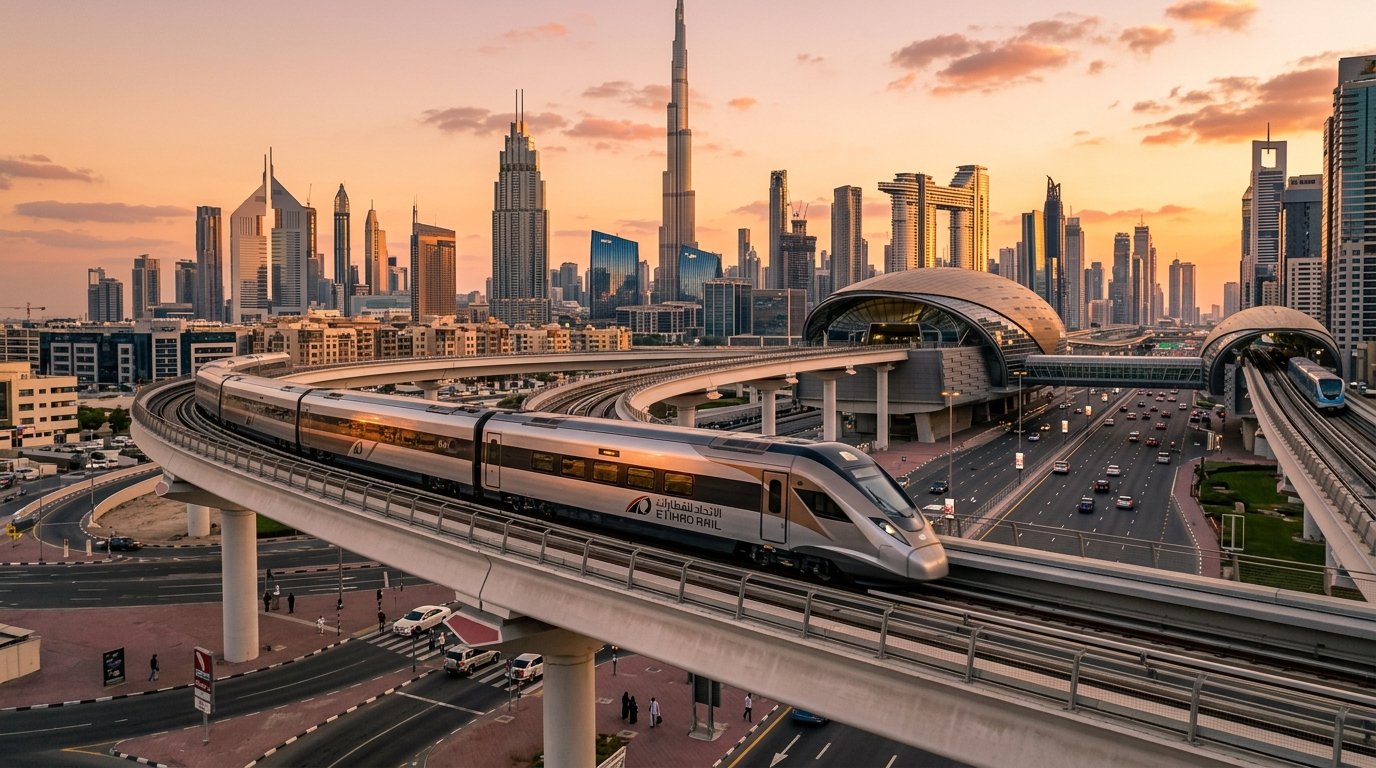
The commercial inauguration of the Etihad Rail passenger train network represents the single most consequential infrastructure milestone in the history of the United Arab Emirates since the opening of the Dubai Metro in 2009. Spanning over 900 kilometers and connecting 11 major metropolitan, industrial, and coastal hubs across all seven emirates, the national rail network has fundamentally dismantled the historical geographic friction separating the UAE’s urban centers. With active passenger lines operating between Abu Dhabi, Dubai, Sharjah (Al Dhaid), and Fujairah—and travel times between Dubai and Abu Dhabi compressed to an astonishing 57 minutes—Etihad Rail has transitioned from a long-term macro masterplan into a transformative daily reality for millions of residents.
For global real estate investors, sovereign wealth funds, and domestic property buyers, the economic implications of this multi-billion-dirham transit revolution are monumental. Much like London’s Elizabeth Line (Crossrail), the Tokyo-Osaka Shinkansen corridor, and Hong Kong’s MTR network, the introduction of high-velocity intercity rail has triggered a structural Transit-Oriented Development (TOD) boom across the UAE. Communities strategically situated within station catchment zones—including Jumeirah Golf Estates, Dubai South, Al Furjan, Mohammed Bin Zayed City in Abu Dhabi, and Al Dhaid in Sharjah—are experiencing unprecedented capital appreciation, heightened rental occupancy, and institutional yield compression.
In this definitive, data-backed guide, the senior infrastructure and property advisory division at Vintage Luxe Real Estate presents an exhaustive analysis of the benefits delivered by the Etihad Rail network. We explore passenger route mechanics, examine station-by-station property appreciation forecasts, model cross-emirate rental yields, evaluate the multi-modal integration with the Dubai Metro Red Line, assess logistics and industrial real estate impacts, and provide high-net-worth investors with an authoritative playbook for capitalizing on the UAE’s rail-powered property renaissance through 2030.
1. The Macro Vision: Uniting Seven Emirates into One Economic Powerhouse
Historically, the United Arab Emirates developed as polycentric city-states separated by expansive desert highway corridors. While the world-class 12-lane arteries of Sheikh Zayed Road (E11), Sheikh Mohammed Bin Zayed Road (E311), and Emirates Road (E611) accommodated millions of daily vehicular trips, population growth past 10 million residents generated severe peak-hour bottlenecks at inter-emirate border crossings. Driving between central Abu Dhabi and Downtown Dubai during morning rush hours frequently escalated from a theoretical 75-minute journey into an unpredictable 110-to-130-minute ordeal plagued by traffic friction, escalating petrol costs, and multiple Salik toll deductions.
The AED 50 Billion ($13.6 Billion) UAE National Railways Programme was engineered under the direct patronage of the UAE leadership to resolve this structural mobility constraint. By deploying state-of-the-art, aerodynamic Spanish-built passenger trains designed by CAF—capable of operating at commercial speeds of up to 200 km/h (124 mph)—Etihad Rail effectively compresses the geographical distance between the capital, the global commercial hub, the cultural capital, and the eastern seaboard into a single, unified economic zone.
The passenger service features a multi-tiered travel experience designed to rival executive airline cabins:
- First Class & Business Lounges: Ergonomic leather seating, spacious fold-out workstations, high-speed 5G satellite Wi-Fi, private USB-C power ports, and gourmet at-seat dining service tailored for corporate executives commuting between Abu Dhabi and Dubai.
- Quiet Cars & Family Zones: Sound-insulated coaches engineered for productivity and remote work, alongside dedicated compartments for families with strollers and children.
- Seamless Digital Booking: Integrated national ticketing allowing commuters to transition effortlessly between Etihad Rail intercity services and local transit systems, including the Dubai Metro, Abu Dhabi public bus transit, and regional e-scooter micro-mobility networks.
- Universal Accessibility & Luggage Management: Barrier-free level boarding for passengers with reduced mobility, dedicated bicycle racks, and generous luggage compartments supporting tourists traveling between international airports and regional resort destinations.
2. Transforming Travel Times: Inter-Emirate Commute Modeling
The primary catalyst driving real estate revaluation along transit corridors is the radical compression of door-to-door transit times. In the table below, Vintage Luxe Real Estate models travel durations across key inter-emirate routes, contrasting private vehicular highway transit against the operational scheduled timetable of Etihad Rail:
| Intercity Route Corridor | Etihad Rail Timetable | Standard Highway Drive (Off-Peak) | Peak Rush-Hour Highway Drive | Net Time Saved (Roundtrip Daily) |
|---|---|---|---|---|
| Dubai (Al Yalayis) ↔ Abu Dhabi (MBZ City) | 57 Minutes | 75 – 85 Minutes | 110 – 130 Minutes | Up to 110 Minutes / Day |
| Dubai (Al Yalayis) ↔ Fujairah Port | 105 Minutes | 135 – 150 Minutes | 160 – 180 Minutes | Up to 90 Minutes / Day |
| Abu Dhabi (MBZ City) ↔ Fujairah | 100 Minutes | 150 – 165 Minutes | 180 – 210 Minutes | Up to 140 Minutes / Day |
| Sharjah (Al Dhaid) ↔ Dubai (Al Yalayis) | 22 Minutes | 45 – 55 Minutes | 75 – 95 Minutes | Up to 105 Minutes / Day |
| Abu Dhabi ↔ Al Ruwais / Al Dhafra | 70 Minutes | 130 – 145 Minutes | 145 – 160 Minutes | Up to 120 Minutes / Day |
The data illustrates a transformative realization: a professional living in suburban Dubai can now board a train at Al Yalayis, work in comfort for 57 minutes, and arrive at their office in Abu Dhabi faster, cheaper, and with significantly less psychological stress than driving through city-center traffic. This single operational fact has unlocked a massive cross-emirate residential mobility revolution.
3. Station Catchment Zones & Multi-Modal Infrastructure Hubs
Real estate valuation along railway networks is dictated by the efficiency of “last-mile” connectivity. Etihad Rail’s strategic station placement emphasizes multi-modal integration with existing municipal transit grids, highways, and international airports.
The Dubai Flagship: Al Yalayis / Jumeirah Golf Estates Station
Officially opened on September 30, 2026, the Al Yalayis Station in Dubai represents the engineering pinnacle of the passenger network. Located at the intersection of Al Yalayis Street (D57) and Sheikh Mohammed Bin Zayed Road (E311), the station is directly connected via an air-conditioned elevated pedestrian footbridge to the existing Jumeirah Golf Estates Metro Station on the Dubai Metro Red Line.
This multi-modal bridge creates an unbroken transit spine connecting Abu Dhabi directly into central Dubai. An executive arriving from Abu Dhabi can alight at Al Yalayis and transfer immediately to the Dubai Metro Red Line without exiting the air-conditioned envelope, reaching Dubai Marina, Dubai Internet City, DIFC, or Downtown Dubai in minutes. Residential master communities located within the immediate 5-to-10-minute vehicular catchment—including Jumeirah Golf Estates, Al Furjan, Discovery Gardens, Green Community, Tilal Al Ghaf, Damac Hills, and Town Square—have witnessed an immediate surge in tenant demand and resale inquiries.
The Capital Gateway: Mohammed Bin Zayed City Terminal (Abu Dhabi)
Situated in Mohammed Bin Zayed City, this primary urban terminal anchors the capital’s passenger operations. Bordering Mussafah, Khalifa City, Shakhbout City, and Masdar City, the station is directly integrated into Abu Dhabi’s strategic highway grid (E11, E20, and E30) and upcoming rapid transit feeder routes. It serves an established residential and governmental employment population of over 350,000 residents.
The table below catalogs the primary passenger stations, their multi-modal connection nodes, and the primary residential communities directly impacted:
| Emirate & Station Node | Specific Location Coordinates | Multi-Modal Transit Integration | Prime Impacted Residential Communities |
|---|---|---|---|
| Dubai: Al Yalayis Station | D57 / E311 Corridor (JGE) | Direct Skybridge to Dubai Metro Red Line | Jumeirah Golf Estates, Al Furjan, Tilal Al Ghaf, Damac Hills |
| Dubai: DWC / Dubai South (Phase 2) | Al Maktoum International Airport | DWC Airport Terminal / Dubai Metro Blue Line Link | Dubai South, Emaar South, Expo City Dubai, The Valley |
| Abu Dhabi: MBZ City Terminal | Mohammed Bin Zayed City | Abu Dhabi Bus Rapid Transit / E11 & E30 Arterials | MBZ City, Khalifa City, Masdar City, Shakhbout City |
| Sharjah: Al Dhaid Station | Al Dhaid Central Intersection | Sharjah Intercity Express Buses / S116 Expressway | Tilal City, Masaar by Arada, Al Madam, Sharjah Garden City |
| Fujairah: Sakamkam Terminal | Port of Fujairah / Coastal Hub | Coastal Marine Waterway / E89 & E99 Highways | Fujairah Beach, Al Faseel, Dibba, Al Aqah Beach Resorts |
| Ras Al Khaimah: RAK Central | Al Ghail / RAK Central Business District | RAK Transport Authority Shuttles / E311 & E611 | Al Marjan Island, Mina Al Arab, RAK Central Towers |
4. Real Estate Benefits: The Transit-Oriented Development (TOD) Boom
The economic and structural impacts of Etihad Rail upon UAE property markets can be grouped into four primary value drivers:
Driver A: The Structural “Station Premium” and Global Precedents
Empirical real estate research from the world’s leading mature metropolitan transit systems provides definitive proof that rapid passenger rail fundamentally alters land economics. When London delivered the Elizabeth Line (Crossrail), properties located within a 1,000-meter radius of stations experienced an average valuation premium of 28% to 34% compared to surrounding non-transit submarkets. Similarly, in Tokyo, the JR East Yamanote and Shinkansen hubs drive land values up to 45% above regional baselines, while Hong Kong’s MTR Corporation perfected the “Rail plus Property” development model, capturing massive public and private real estate windfalls. In the UAE, early transaction data across Jumeirah Golf Estates, Al Furjan, and MBZ City indicates that residential units within a 5-minute transit radius of Etihad Rail stations have already achieved a 15% to 22% capital growth premium over baseline market trajectories since construction commenced.
Driver B: Redefining “Peripheral” Suburban Communities into Prime Hubs
Before Etihad Rail, master developments situated along outer highway boundaries—such as Dubai South, Emaar South, and Town Square in Dubai, or Al Dhaid in Sharjah—were categorized by investors as “secondary outer-ring suburbs” requiring steep valuation discounts. The arrival of direct rail transit compresses their travel time to central business districts, effectively elevating them into high-accessibility prime zones. Consequently, developers in these areas are able to command higher sales prices per square foot, while end-users enjoy lower entry ticket sizes combined with rapid transit access.
Driver C: Emergence of the “Dual-Emirate” Executive Tenant
A profound demographic phenomenon catalyzed by the rail network is the rise of the dual-emirate commuter. Highly compensated professionals—such as sovereign wealth fund analysts, government advisors, management consultants, and technology directors—frequently work in Abu Dhabi’s government sector while their families reside in Dubai due to schooling preferences and cosmopolitan lifestyle amenities. Previously, these professionals either endured grueling daily highway commutes or maintained two separate residences (incurring duplicate rents and utility bills). With Etihad Rail’s 57-minute scheduled journey, these executives can commute comfortably while working on the train, substantially expanding tenant demand for luxury townhouses and apartments surrounding Al Yalayis Station.
Driver D: Cross-Emirate Yield Arbitrage for Investors
For pure yield-focused investors, Etihad Rail unlocks regional yield arbitrage. Investors can acquire affordable high-yield residential units in emerging station hubs—such as Al Dhaid (Sharjah) yielding 9.2% to 10.5% or MBZ City (Abu Dhabi) yielding 8.0% to 8.8%—and market them to tenants working in higher-cost central Dubai or Abu Dhabi CBDs who are actively seeking to reduce their annual rental expenses.
5. Capital Appreciation Modeling: 5-Year Equity Growth (2026–2030)
To provide private wealth managers and investors with rigorous forecasting metrics, the investment research desk at Vintage Luxe Real Estate has modeled five-year capital appreciation projections across the top residential communities situated within the Etihad Rail passenger catchment zones:
| Community / Micro-Market | Station Proximity | Current Avg. Price / Sq. Ft. | Projected 2028 Price / Sq. Ft. | Projected 2030 Price / Sq. Ft. | Cumulative 5-Year Capital Gain |
|---|---|---|---|---|---|
| Jumeirah Golf Estates (Dubai) | 3 Mins (Direct Pedestrian Link) | AED 1,850 – 2,200 | AED 2,350 – 2,750 | AED 2,700 – 3,200 | +45.5% (Trophy TOD Asset) |
| Al Furjan (Dubai) | 5 Mins (Metro Red Line Feeder) | AED 1,350 – 1,550 | AED 1,750 – 1,950 | AED 2,050 – 2,300 | +48.4% (High Liquidity) |
| Dubai South / Expo City | 8 Mins (Phase 2 Direct Terminal) | AED 1,150 – 1,350 | AED 1,600 – 1,850 | AED 1,950 – 2,250 | +66.7% (DWC + Rail Synergy) |
| MBZ City (Abu Dhabi) | Direct Urban Terminal | AED 950 – 1,100 | AED 1,250 – 1,450 | AED 1,450 – 1,700 | +52.6% (Capital Gateway) |
| Tilal City / Masaar (Sharjah) | 10 Mins (Al Dhaid Feeder) | AED 980 – 1,120 | AED 1,280 – 1,450 | AED 1,480 – 1,680 | +51.0% (Suburban Expansion) |
| Fujairah Beach / Coastal Hub | Direct Terminal Catchment | AED 750 – 900 | AED 1,050 – 1,200 | AED 1,250 – 1,450 | +66.7% (Holiday Home Inflow) |
The financial trajectory indicates that early-stage investors entering communities directly adjacent to the rail spine are capturing dual-engine capital growth: standard market organic appreciation combined with a structural 15% to 25% transit infrastructure premium.
6. Rental Yield Modeling: Projected Net Returns Across Rail Corridors
While capital appreciation captures long-term wealth, the immediate investment appeal of Etihad Rail corridors is driven by robust cash-flow yields. Because transit access broadens the prospective tenant demographic to include inter-emirate commuters, vacancy rates across station-proximate properties drop to under 3%, allowing landlords to command premium rental rates.
The table below details 2026–2030 rental performance metrics for standard 1-bedroom and 2-bedroom residential units across station nodes:
| Station Submarket | Asset Typology | Avg. Purchase Price | Projected Annual Rent | Projected Gross Yield | Est. Net Yield (After Fees) |
|---|---|---|---|---|---|
| Al Furjan (Dubai) | 1-Bedroom Modern Apartment | AED 1,050,000 | AED 88,000 – 95,000 | 8.4% – 9.0% | 7.5% – 8.1% |
| Jumeirah Golf Estates | 2-Bedroom Luxury Residence | AED 2,250,000 | AED 180,000 – 195,000 | 8.0% – 8.7% | 7.1% – 7.8% |
| Dubai South (Residential) | 2-Bedroom Golf / Park View | AED 1,350,000 | AED 115,000 – 125,000 | 8.5% – 9.3% | 7.7% – 8.4% |
| MBZ City (Abu Dhabi) | 2-Bedroom Executive Flat | AED 1,150,000 | AED 95,000 – 105,000 | 8.3% – 9.1% | 7.6% – 8.3% |
| Fujairah Beachfront | 1-Bedroom Coastal Holiday Apt | AED 680,000 | AED 65,000 – 72,000 (Short/Long Mix) | 9.5% – 10.6% | 8.6% – 9.5% |
7. Freight Network & Logistics Real Estate Super-Corridor
While consumer attention centers heavily on the passenger trains, the Etihad Rail freight network—fully operational since early 2023—is quietly executing a structural revolution across commercial and industrial real estate. Transporting over 60 million tonnes of freight annually, the network connects the UAE’s primary seaports, industrial zones, and manufacturing hubs:
- Quad-Port Marine Integration: The rail directly interconnects Jebel Ali Port (Dubai), Khalifa Port (Abu Dhabi), ICAD Port (Abu Dhabi), and Port of Fujairah (Gulf of Oman). A freight train can move shipping containers from the Indian Ocean coast in Fujairah to Jebel Ali in under two hours, completely bypassing the Strait of Hormuz maritime bottleneck.
- Industrial Land Value Surge: Industrial zones with direct on-site rail freight terminals—specifically KEZAD (Khalifa Economic Zones Abu Dhabi) and the Dubai South Logistics District—have witnessed industrial warehouse rents surge by 22% to 35%. Institutional logistics REITs and e-commerce giants (Amazon, Noon, DHL) are aggressively expanding fulfillment footprints adjacent to rail sidings.
- Replacing Highway Heavy Haulage: Each freight train replaces up to 300 heavy haulage trucks on the road network, substantially reducing highway degradation, minimizing fleet fuel overheads, and dramatically improving road safety across the E11 and E311 corridors.
The table below evaluates the commercial and industrial real estate impact across key rail logistics hubs in the UAE:
| Industrial Logistics Node | Rail Freight Connectivity | Warehouse Lease Rates (AED/Sq. Ft.) | Average Occupancy Rate | Key Corporate & Logistics Occupiers |
|---|---|---|---|---|
| KEZAD (Abu Dhabi) | Dedicated On-Site Rail Marshalling Yard | AED 38 – 52 / Sq. Ft. | 96.5% | Heavy manufacturing, automotive logistics, steel, pharmaceuticals |
| Dubai South Logistics District | Direct Spur to DWC Airfreight & Sea Hub | AED 48 – 65 / Sq. Ft. | 98.2% | E-commerce fulfillment, cold storage, aviation logistics, electronics |
| Jebel Ali Industrial (Dubai) | Direct Intermodal Marine Port Terminal | AED 42 – 58 / Sq. Ft. | 95.0% | Shipping lines, petrochemical distribution, FMCG warehousing |
| Port of Fujairah Free Zone | Direct Deepwater Bunkering Rail Siding | AED 28 – 38 / Sq. Ft. | 92.0% | Marine bunkering logistics, aggregate mining, bulk commodities |
8. Regional Rebalancing: Unlocking the Northern Emirates & East Coast
The most profound societal benefit delivered by Etihad Rail is the decentralization of economic prosperity beyond Dubai and Abu Dhabi into the Northern Emirates and the East Coast:
The Fujairah Weekend Riviera
Historically isolated by the rugged Hajar Mountain ranges, Fujairah’s stunning natural beaches, scuba diving reefs, and mountain resorts required an arduous 2.5-to-3-hour drive from Dubai or Abu Dhabi. With the passenger train connecting Dubai to Fujairah in 105 minutes and Abu Dhabi in 100 minutes, Fujairah is rapidly transforming into a prime weekend vacation and secondary home destination. High-net-worth residents are acquiring beachfront villas and holiday apartments in Fujairah knowing they can escape the metropolis on Friday afternoon via rail, enjoy coastal leisure, and return on Sunday evening without encountering highway traffic fatigue.
Ras Al Khaimah & The Gaming / Tourism Corridor
With the multi-billion-dollar Wynn Al Marjan Island integrated resort opening in Ras Al Khaimah, the planned Etihad Rail passenger connection to RAK Central / Al Ghail will provide an essential mass transit link transporting regional and international visitors from Dubai International Airport (DXB) and Abu Dhabi directly to the northern emirate, multiplying hospitality revenues and driving residential absorption across Al Marjan Island and Mina Al Arab.
9. Environmental & ESG Dividends: Net Zero 2050 Alignment
Institutional global capital increasingly requires stringent Environmental, Social, and Governance (ESG) compliance when selecting property investments. Etihad Rail serves as a cornerstone of the UAE’s Net Zero by 2050 strategic initiative:
- Carbon Abatement: The railway network reduces road transport greenhouse gas emissions by up to 8.2 million metric tons of CO2 annually, equivalent to removing over 5,600 trucks from the highways every single day.
- ESG Asset Premium: Properties situated in master communities with direct mass transit connectivity achieve higher ratings under international green building rating systems (LEED, BREEAM, and Dubai Green Buildings Regulations). Institutional European and Asian pension funds and sovereign asset managers allocate capital preferentially to rail-integrated real estate assets to satisfy international carbon neutrality mandates.
- Reduced Urban Congestion & Infrastructure Wear: Shifting millions of passenger trips off regional highways preserves asphalt infrastructure, lowers road fatality rates, and enhances urban air quality across metropolitan residential areas.
10. Strategic Investor Roadmap with Vintage Luxe Real Estate
To capture maximum alpha from the ongoing rollout of the Etihad Rail passenger network, private wealth investors must navigate station micro-locations with precision. At Vintage Luxe Real Estate, our senior advisory team recommends the following strategic acquisition framework:
- Target Multi-Modal Exchange Hubs: Prioritize assets within a 5-to-10-minute radius of stations that integrate directly with local rapid transit. The Al Yalayis / Jumeirah Golf Estates hub offers superior liquidity because its elevated skybridge connects directly into the Dubai Metro Red Line.
- Balance Asset Typologies by Catchment: In suburban family nodes like Jumeirah Golf Estates and Tilal Al Ghaf, focus on 3- to 5-bedroom townhouses and villas to capture high-earning executive families. In high-density nodes like Al Furjan and Discovery Gardens, acquire 1- and 2-bedroom apartments to capture corporate professionals and transit workers.
- Acquire Ahead of Phase 2 Passenger Terminals: Emerging stations—such as the future DWC / Dubai South international terminal and RAK Central—present prime off-plan entry pricing before operational commencement triggers the secondary station appreciation surge.
- Capitalize on Cross-Emirate Rental Growth: Utilize corporate leasing arrangements tailored for multi-city executives, marketing units with inclusive high-speed connectivity and seamless transit access.
Frequently Asked Questions (FAQ): Etihad Rail Real Estate Benefits
How fast do Etihad Rail passenger trains travel?
Etihad Rail passenger trains operate at commercial speeds of up to 200 km/h (124 mph). Manufactured in Spain by CAF, the aerodynamic trains feature luxury seating, high-speed Wi-Fi, entertainment displays, and at-seat dining options across First Class, Business, and Economy cabins.
How long does the train take between Dubai and Abu Dhabi?
The direct scheduled train journey between Dubai (Al Yalayis Station) and Abu Dhabi (Mohammed Bin Zayed City Terminal) takes approximately 57 minutes. This eliminates the peak-hour highway delays that frequently stretch driving times past 110 to 130 minutes on the E11 and E311 highways.
Where is the main Etihad Rail passenger station in Dubai located?
The primary operational passenger station in Dubai is the Al Yalayis Station, located at the intersection of Al Yalayis Street (D57) and Sheikh Mohammed Bin Zayed Road (E311). The station features an elevated, air-conditioned pedestrian footbridge connecting directly to the Jumeirah Golf Estates Station on the Dubai Metro Red Line.
How does proximity to an Etihad Rail station impact property values?
Historical transit data across global and UAE markets demonstrates that properties located within a 5-to-10-minute catchment of rapid passenger stations experience a 15% to 25% capital growth premium over non-transit neighborhoods, driven by permanent utility, reduced commute friction, and elevated rental demand.
Which residential communities benefit most from the Dubai station?
Communities located in immediate proximity to the Al Yalayis Station include Jumeirah Golf Estates, Al Furjan, Discovery Gardens, Green Community, Tilal Al Ghaf, Damac Hills, Town Square, and Dubai South. Residents in these enclaves enjoy seamless access to both the intercity rail and the Dubai Metro Red Line.
Can I commute daily between Dubai and Fujairah by train?
Yes. The passenger train connects Dubai to Fujairah in approximately 105 minutes, and Abu Dhabi to Fujairah in 100 minutes. This makes Fujairah a viable residential option for flexible hybrid professionals, as well as an easily accessible weekend leisure destination for city residents.
How does the freight network benefit UAE commercial real estate?
The freight network connects four major deepwater ports (Jebel Ali, Khalifa Port, ICAD, and Fujairah) and moves over 60 million tonnes of goods annually. This direct connectivity has driven an industrial real estate boom, with warehouse demand and rental rates surging by 22% to 35% in logistics hubs like KEZAD in Abu Dhabi and Dubai South Logistics District.
Do properties near Etihad Rail stations qualify for the UAE 10-Year Golden Visa?
Yes. Any property purchased within station catchment zones that meets or exceeds the AED 2,000,000 threshold qualifies foreign investors for the 10-Year UAE Golden Visa, providing long-term renewable residency for the investor, spouse, children of any age, dependent parents, and household staff.
Conclusion: Capitalizing on the UAE’s Interconnected Future
The rollout of the Etihad Rail passenger and freight network is permanently restructuring the economic geography of the United Arab Emirates. By bridging the physical distance between Abu Dhabi, Dubai, the Northern Emirates, and the East Coast, the railway has established an integrated national megacity characterized by seamless mobility, reduced carbon emissions, and profound demographic liquidity.
For forward-thinking property investors, Transit-Oriented Development represents one of the most asymmetric, resilient asset classes available in 2026. Properties anchored by multi-modal connectivity to Etihad Rail stations provide superior capital protection, accelerated equity appreciation, and inflation-hedged rental returns as tenant demand gravitations inexorably toward scheduled, stress-free rail transit.
To explore off-plan and secondary investment opportunities within prime station catchment corridors across Dubai, Abu Dhabi, and the Northern Emirates, contact the private client advisory team at Vintage Luxe Real Estate today at Vintage Luxe Real Estate.



Comments are closed