





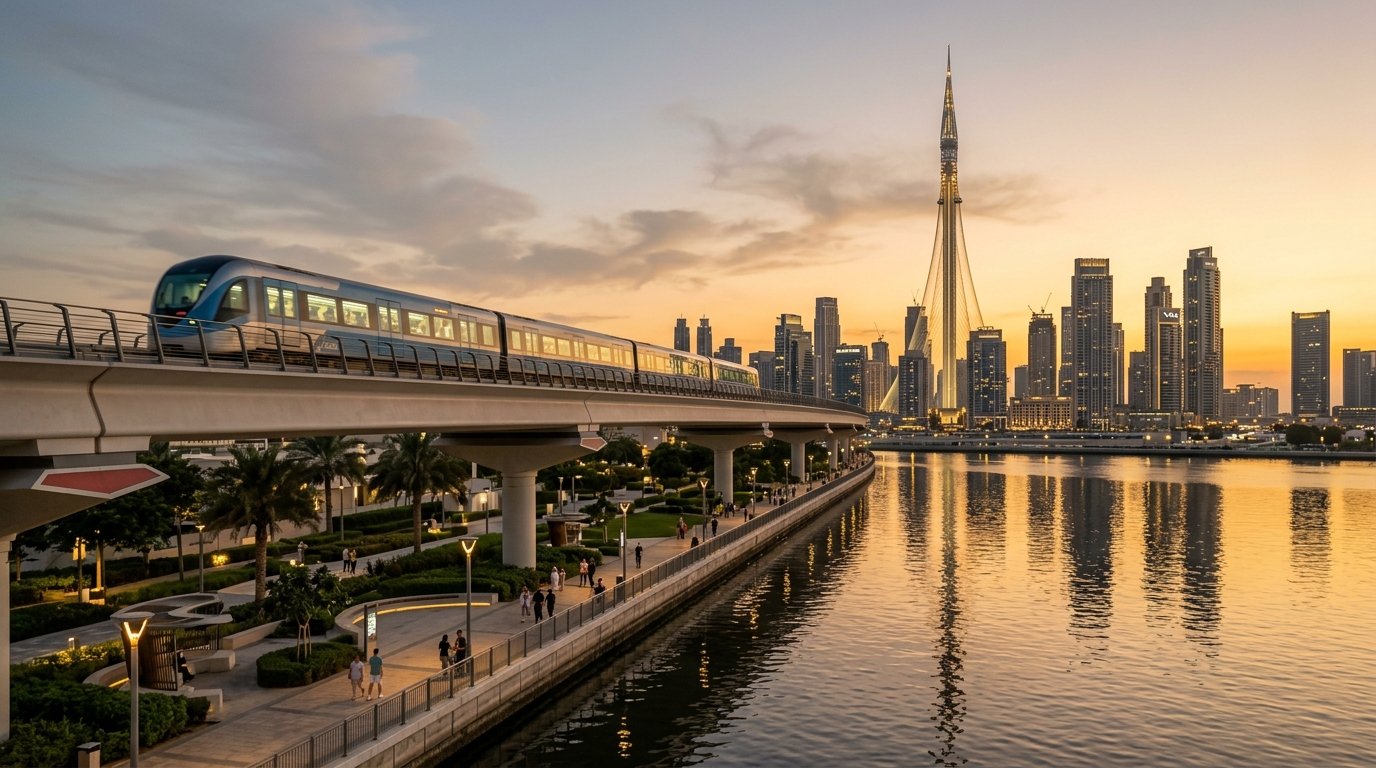
The approval and ongoing development of the AED 18 billion ($4.9 billion) Dubai Metro Blue Line marks the most consequential urban infrastructure milestone in the emirate since the inauguration of the Red Line in 2009. Spanning 30 kilometers across 14 strategically positioned stations, the Blue Line directly bridges the historic gap between the existing Red and Green lines, unlocking seamless mass-transit connectivity for more than one million residents across Dubai’s eastern, southeastern, and creek-side growth corridors. In global real estate hubs, transit-oriented infrastructure investment reliably generates the highest risk-adjusted capital appreciation in urban planning history. Across Dubai’s dynamic property ecosystem, empirical data demonstrates that residential properties situated within a 10-to-15-minute walking radius of an operational metro station command an immediate 18% to 34% capital valuation premium and up to a 220-basis-point yield advantage over transit-detached assets.
Strategic Vision & Engineering Milestones of the Dubai Metro Blue Line
Formally approved by His Highness Sheikh Mohammed bin Rashid Al Maktoum, Vice President and Prime Minister of the UAE and Ruler of Dubai, under the ambitious umbrella of the Dubai 2040 Urban Master Plan, the Dubai Metro Blue Line is engineered to satisfy the transit demands of a city pacing rapidly toward an active daytime population of 7.8 million people. The project encompasses 30 kilometers of total track alignment, strategically bifurcated into two primary operational branches that interface seamlessly with the existing rail network.
The engineering specifications of the Blue Line represent a masterclass in modern civil transportation design. Of the 30-kilometer total alignment, 15.5 kilometers are subterranean (underground tunnels excavated beneath densely populated urban quarters and historical waterways), while 14.5 kilometers are elevated viaducts offering panoramic architectural vistas of Dubai’s expanding skyline. The network incorporates 14 modern stations, comprising 9 elevated stations and 5 underground stations, alongside two critical transfer interchange hubs connecting directly to Centrepoint Station on the Red Line and Creek Station on the Green Line.
Engineering Highlights and Route Breakdown
- Total Network Investment: AED 18 Billion ($4.9 Billion) under Roads and Transport Authority (RTA) oversight.
- Total Alignment Distance: 30 Kilometers (15.5 km underground tunnel alignment, 14.5 km elevated architectural viaduct).
- Station Count: 14 passenger stations (9 elevated, 5 underground, including 3 key interchange terminals).
- Iconic Architectural Landmark: A signature 1,300-meter rail bridge spanning Dubai Creek directly adjacent to Dubai Creek Harbour, representing an engineering feat engineered by world-renowned architects.
- Network Capacity: Designed to transport up to 320,000 passengers daily, removing approximately 56,000 vehicle trips per day from Dubai’s arterial highway network by 2030.
- Completion and Commercial Operations: Phased testing initiating in 2028 with full commercial passenger revenue service launched by early 2029, timed to coincide with major residential handovers.
The Empirical ‘Metro Multiplier’: Historical Capital Appreciation Data (2009–2025)
To accurately forecast the price trajectory of residential real estate adjacent to the Blue Line between 2026 and 2029, institutional and private investors must examine the historical precedent set by earlier phases of Dubai’s rail network. Longitudinal transactional studies conducted by the Dubai Land Department (DLD) and regional property indices across the lifecycle of the Red Line (opened in September 2009) and the Route 2020 Expo extension (opened in January 2021) reveal undeniable macroeconomic patterns.
When the Dubai Metro Red Line launched during the global financial downturn of 2009, properties within 500 meters of stations in Dubai Marina, Jumeirah Lakes Towers (JLT), and Barsha Heights (TECOM) preserved their rental values at rates 28% higher than comparable assets located 2 kilometers away. Between 2011 and 2015, as the wider market recovered, transit-adjacent residential units appreciated at a 32.4% compound annual rate compared to 19.8% for non-transit-serviced clusters. More recently, along the Route 2020 extension serving Al Furjan and Discovery Gardens, capital valuations surged by 42.6% between project groundbreaking and full commercial activation, while gross rental yields compressed upward from 6.8% to 9.2% due to intense tenant competition.
Quantifying the Transit-Oriented Development (TOD) Premium
In mature global transit capitals—such as London with the Elizabeth Line (Crossrail), Hong Kong with the MTR network, and Singapore with the MRT—the economic phenomenon termed the “Transit-Oriented Development (TOD) Premium” follows a predictable three-stage capitalization curve:
- Phase 1: Announcement to Groundbreaking (Current 2025–2026 Window): Initial speculative re-pricing occurs. Developers launch off-plan inventory marketing proximity to planned stations, capturing an initial 8% to 15% pricing uplift over historical baseline values.
- Phase 2: Active Civil Construction (2026–2028): Infrastructure visibility materializes. Tunnelling boring machines (TBMs) deploy, elevated pillars emerge, and end-user buyers begin prioritizing accessibility. Capital values typically expand by an additional 12% to 20% as project delivery risk declines.
- Phase 3: Operational Commissioning (2029 Onward): The full utility value is realized. Thousands of daily commuters, corporate workers, and students immediately alter their commuting patterns. Rental occupancy rates hit 95%+, rental rates surge by 20% to 35%, and institutional yield-seeking funds acquire stabilized assets at compressed capitalization rates, locking in generational capital growth.
Station-by-Station Real Estate Impact Analysis (All 14 Blue Line Stations)
The Blue Line does not impact Dubai uniformly. It weaves through distinctly diverse socio-economic sub-markets ranging from ultra-luxury waterfront master developments and high-density family districts to global university clusters and innovation freezones. Below is a rigorous micro-market analysis of the property dynamics across each major station cluster.
Stations 1 & 2: Dubai Creek Harbour & Ras Al Khor Waterfront
Dubai Creek Harbour (DCH), developed by Emaar Properties, represents the crown jewel of the Blue Line’s northern alignment. Positioned as the “Future Downtown of Dubai,” DCH encompasses over 7.4 million square meters of gross floor area surrounding the Ras Al Khor Wildlife Sanctuary. Historically, the principal critique leveled by prospective buyers against DCH was its reliance on vehicular access via Ras Al Khor Road (E44) and Nad Al Hamar Road.
The introduction of two underground stations—including an iconic station featuring direct access to Creek Marina and the Central Park district—completely dissolves this connectivity bottleneck. Travel time from Creek Horizon and Address Grand Creek Harbour to Downtown Dubai and Dubai International Airport (DXB) will plummet to just 12 to 14 minutes. Premium residential apartments currently trading between AED 2,100 and AED 2,800 per square foot are projected to appreciate toward AED 3,200 to AED 3,600 per square foot by 2029, narrowing the historic valuation spread between Dubai Creek Harbour and Downtown Dubai.
Station 3: Dubai Festival City & Al Badia Residences
Dubai Festival City (DFC), a premier mixed-use waterfront master development by Al-Futtaim Group, gains direct rail connectivity through an elevated station serving Festival City Mall, commercial office towers, and the Al Badia residential enclaves. DFC already enjoys strong long-term occupancy from corporate executives and multinational headquarters. The Blue Line transforms DFC into an accessible transit hub for retail visitors and daily commuters from DSO and Academic City, supporting an expected 22% rental rate expansion across Al Badia Golf Residences and Hillside condominiums.
Station 4: Centrepoint / Al Rashidiya Interchange Hub
Operating as the vital northern terminus bridging the Red Line and the Blue Line, Centrepoint Station in Al Rashidiya expands into a massive multimodal transit nexus. The immediate real estate catchment encompasses mature residential villa zones in Rashidiya and mid-rise apartment communities along Airport Road. For buy-to-let investors, this interchange facilitates continuous, friction-free tenant demand from aviation professionals, airline cabin crew, and logistics executives seeking direct single-seat train commutes to DXB Terminal 1, Terminal 3, and southern employment hubs.
Stations 5 & 6: Al Warqa Residential Corridors (Phases 1–4)
Al Warqa has historically functioned as an established, car-dependent residential community predominantly occupied by Emirati families and long-term Arab expatriates. However, the introduction of two elevated stations along Tripoli Street and the Warqa arterial spine unlocks massive land capitalization potential for private developers holding freehold-designated plots in Al Warqa 1. Mid-rise residential apartment blocks currently yielding 7.5% gross returns are poised for immediate rental repricing, as middle-income families capitalize on direct rail connectivity to major business districts without bearing vehicle fuel and Salik toll overheads.
Stations 7 & 8: Mirdif Uptown & Mushrif Urban Enclaves
Mirdif is globally celebrated for its low-rise, leafy, community-centric ambiance, anchored by Mirdif City Centre and Uptown Mirdif. Traditionally insulated from the metro network due to noise considerations and distance, the Blue Line introduces an underground and subterranean station alignment along the periphery of Mirdif and Mushrif Park. This strategic configuration preserves Mirdif’s serene architectural aesthetic while providing residents with 18-minute transit access to Business Bay. Townhouses and low-rise apartments within Ghoroob and Shorooq will capture immediate occupancy premiums, driving capital valuations upward by a projected 24% by 2028.
Stations 9 & 10: International City (Phases 1 & 2) & Dragon Mart Commercial Hub
International City represents one of Dubai’s highest-density, highest-yielding residential micro-markets, home to over 200,000 residents and the colossal Dragon Mart trade complex. Despite generating outstanding historical gross rental yields ranging from 9.0% to 11.2%, capital values in International City have historically lagged prime Dubai averages due to severe vehicular traffic congestion along Al Awir Road (E44) and Sheikh Mohammed Bin Zayed Road (E311).
The Blue Line serves as a revolutionary urban unblocking mechanism for International City. Two elevated stations directly servicing Phase 1 and Warsan 4 will slash peak commute times by up to 55 minutes. Affordable studio and one-bedroom units currently priced at AED 420,000 to AED 650,000 will attract massive interest from value-focused institutional buy-to-let syndicates seeking stable cash-flowing residential portfolios with projected net rental yields remaining above 8.5%.
Stations 11 & 12: Dubai Silicon Oasis (DSO) Innovation Freezone
Dubai Silicon Oasis (DSO) is the definitive epicenter of capital appreciation on the entire Blue Line alignment. As a designated technology, AI, and smart-city freezone spanning 7.2 million square meters, DSO hosts over 100,000 residents and thousands of tech enterprises, startup incubators, and multinational R&D centers. Despite its exceptional infrastructure, high-quality schools, and world-class tech facilities, DSO property values have suffered from a lack of direct rail infrastructure.
With two prominent stations—one servicing the commercial Silicon Central Mall and central technology park, and the second servicing the residential DSO gate corridor—DSO is set to experience a monumental real estate re-rating. Travel time from DSO to Downtown Dubai will contract from 45 minutes by car in peak rush-hour traffic to just 18 minutes by train. Prime residential towers such as Binghatti Stars, Silicon Heights, and Arabian Gate, currently trading at an accessible AED 1,050 to AED 1,350 per square foot, are forecasted to surge beyond AED 1,700 per square foot by 2029—a staggering 35% to 45% capital appreciation trajectory.
Stations 13 & 14: Dubai Academic City Knowledge Hub & Student Corridor
Serving as the southern anchor of the Blue Line’s eastern branch, Dubai International Academic City (DIAC) is the world’s largest higher education freezone, hosting more than 30 prestigious international universities and an active student body exceeding 32,000 scholars from 150 nations. The lack of mass transit has historically forced students and faculty into costly private car ownership or slow bus transit.
The delivery of two modern stations in Academic City catalyzes an entirely new asset class in Dubai real estate: Purpose-Built Student Accommodation (PBSA). Institutional real estate funds and private developers are rapidly acquiring plots to develop dedicated, micro-living student housing developments. Student housing assets near Academic City stations will generate virtually recession-proof gross rental yields ranging from 9.5% to 11.0%, supported by guaranteed 10-month to 12-month university lease contracts.
Dubai Metro Blue Line Station Real Estate Impact Forecast (2026–2029)
The comprehensive matrix below synthesizes current baseline property metrics, projected capital valuation increases, and anticipated net rental yields across all micro-markets directly impacted by the Dubai Metro Blue Line:
| Station Identifier | Micro-Market Community | Current Avg Price/Sq Ft | 2026–2029 Capital Growth Forecast | Projected Net Rental Yield | Transit Time to Downtown |
|---|---|---|---|---|---|
| Station 1 (Creek Interchange) | Dubai Creek Harbour South | AED 2,350 – 2,750 | +32.5% to +38.0% | 6.8% – 7.4% | 12 mins |
| Station 2 (Creek Marina) | Creek Marina & Central Park | AED 2,500 – 3,100 | +28.0% to +35.0% | 6.5% – 7.1% | 14 mins |
| Station 3 (Festival City) | Dubai Festival City / Al Badia | AED 1,600 – 2,100 | +22.0% to +27.5% | 7.2% – 7.8% | 15 mins |
| Station 4 (Centrepoint) | Al Rashidiya / Airport Enclave | AED 980 – 1,250 | +18.5% to +24.0% | 7.9% – 8.5% | 18 mins |
| Station 5 (Al Warqa West) | Al Warqa 1 Freehold Corridors | AED 950 – 1,180 | +26.0% to +31.5% | 8.1% – 8.8% | 20 mins |
| Station 6 (Al Warqa Central) | Al Warqa 2 & 3 Residential | AED 920 – 1,100 | +21.0% to +26.0% | 7.8% – 8.4% | 22 mins |
| Station 7 (Mirdif South) | Mirdif Uptown / Shorooq | AED 1,150 – 1,450 | +23.5% to +28.0% | 7.4% – 8.0% | 20 mins |
| Station 8 (Mushrif Park) | Mushrif Parkside Villas | AED 1,100 – 1,350 | +19.0% to +24.5% | 7.1% – 7.7% | 22 mins |
| Station 9 (International City 1) | International City Central Clusters | AED 650 – 820 | +31.0% to +37.0% | 9.2% – 10.4% | 24 mins |
| Station 10 (Dragon Mart) | Dragon Mart Trade Hub / Warsan | AED 700 – 880 | +29.0% to +34.5% | 8.8% – 9.8% | 23 mins |
| Station 11 (Silicon Oasis North) | DSO Silicon Central / Tech Park | AED 1,100 – 1,380 | +38.0% to +46.0% | 8.3% – 9.1% | 18 mins |
| Station 12 (Silicon Oasis South) | DSO Residential Gate & Villas | AED 1,050 – 1,300 | +35.0% to +42.0% | 8.0% – 8.7% | 20 mins |
| Station 13 (Academic City North) | University Campuses Cluster | AED 900 – 1,150 | +33.0% to +40.0% | 9.0% – 10.2% | 24 mins |
| Station 14 (Academic City Terminus) | Student Village & R&D Centers | AED 880 – 1,100 | +30.0% to +36.5% | 9.2% – 10.5% | 26 mins |
Rental Yield Projections: Long-Term vs Short-Term (DTCM) Performance
The delivery of rail infrastructure fundamentally transforms the operational cash flow characteristics of residential real estate. In Dubai’s established prime zones such as Dubai Marina and Downtown Dubai, short-term holiday home rentals regulated under the Department of Economy and Tourism (DET / DTCM) generate substantial gross yield premiums over conventional annual Ejari tenancies. However, along the Blue Line alignment, the rental market will bifurcate into two distinct monetization strategies:
Strategy A: High-Occupancy Corporate & Tourist Short-Term Rentals (Dubai Creek Harbour & Festival City)
In Dubai Creek Harbour and Dubai Festival City, direct metro links unlock lucrative short-term holiday home potential. International tourists, digital nomads, and corporate business visitors will no longer perceive DCH as an isolated residential enclave. With 12-minute rail access to the Dubai World Trade Centre (DWTC) exhibition grounds and 10 minutes to DXB Airport, fully furnished one-bedroom and two-bedroom apartments will achieve projected year-round occupancy rates of 82% to 88%. This translates to projected net yields of 7.8% to 9.2%, outperforming traditional annual leases by 180 to 240 basis points after deducting property management and DTCM licensing overheads.
Strategy B: Ultra-Stable Long-Term Tech & Academic Leases (Silicon Oasis & Academic City)
Conversely, in Dubai Silicon Oasis, International City, and Academic City, investors should execute disciplined long-term leasing mandates. Tenant demographics across these nodes comprise software engineers, technology startup staff, research professors, and medical specialists. These professionals prioritize budget predictability and multi-year stability. Leased under standard RERA tenancy contracts with 1 to 4 rental cheques, landlords will enjoy near-zero vacancy loss, minimal interior wear-and-tear, and bulletproof net yields consistently clearing 8.0% to 9.5% annually.
Off-Plan vs. Ready Properties: Strategic Timing Along the Blue Line Corridor
One of the most critical decisions confronting property investors today is capital allocation between off-plan developer launches and ready secondary market stock located along the Blue Line route. Each strategy provides distinct risk-return profiles tailored to specific portfolio objectives.
The Off-Plan Advantage: Structured Leverage and Capital Staging
Top-tier master developers—predominantly Emaar Properties in Dubai Creek Harbour, Sobha Realty along Ras Al Khor, and leading private developers in DSO and Warsan—are aggressively designing payment plans specifically aligned with the Blue Line’s construction timeline. Investors entering off-plan projects launching between 2025 and 2026 benefit from standard 60/40, 70/30, or 80/20 milestone structures tied strictly to certified DLD construction stages. By deploying equity incrementally over a 3-to-4-year horizon, investors achieve massive return on equity (ROE), capturing total project capital appreciation across the entire asset value while having funded only 40% to 60% of the purchase price prior to metro commissioning.
The Ready Property Strategy: Immediate Cash Flow and In-Place Discount Capture
For investors focused primarily on immediate income generation, acquiring ready apartments in Dubai Silicon Oasis and International City between 2025 and 2026 offers an exceptional arbitrage window. Many existing property owners in these mature communities have not yet priced the upcoming 2028–2029 transit connectivity premium into their current secondary market asking prices. Savvy cash buyers can acquire fully tenanted, ready stock at compressed price-per-square-foot valuations, collect immediate 8.5%+ net rental yields today, and ride the compounding appreciation wave as civil viaduct construction advances through 2027 and 2028.
Commercial, Tech Campus, and Co-Working Real Estate Catalysts
While residential appreciation commands dominant headlines, the commercial real estate impact of the Dubai Metro Blue Line is equally transformative. Modern corporate tenants across the GCC are fundamentally reassessing their corporate office footprints based on green environmental criteria and public transit accessibility. Under international ESG (Environmental, Social, and Governance) mandates, global technology enterprises actively avoid commercial buildings that lack direct rail infrastructure.
The Blue Line completely revitalizes commercial office vacancy rates in Dubai Silicon Oasis and Dubai Festival City. Grade-A commercial office buildings in DSO—such as the Silicon Oasis Headquarters and Dubai Digital Park—will attract regional headquarters currently clustered in high-rent Downtown and DIFC zones. Mid-tier multinational technology firms can establish expansive corporate headquarters in DSO at AED 110 to AED 160 per square foot, providing their employees with direct 18-minute subway access to Downtown Dubai while saving up to 45% on corporate leasing overheads.
Commute Efficiency & Urban Congestion Mitigation: Travel Time Benchmarks
The true economic engine driving real estate appreciation is time recovery. The table below illustrates the dramatic commuter travel time reductions engineered by the Dubai Metro Blue Line compared to current rush-hour vehicular commute times:
| Commute Origin & Destination | Current Peak Car Commute | Blue Line Rail Transit Time | Daily Time Saved | Annual Fuel/Salik Savings (Est.) |
|---|---|---|---|---|
| Silicon Oasis to Downtown Dubai | 42 – 55 mins | 18 mins | Up to 70 mins/day | AED 14,200 / year |
| Dubai Creek Harbour to DXB Airport | 25 – 35 mins | 10 mins | Up to 40 mins/day | AED 9,800 / year |
| Academic City to Dubai Marina | 55 – 75 mins | 32 mins (Interchange) | Up to 80 mins/day | AED 16,500 / year |
| International City to Business Bay | 48 – 65 mins | 22 mins | Up to 75 mins/day | AED 15,100 / year |
| Mirdif to Dubai Creek Harbour | 28 – 40 mins | 12 mins | Up to 50 mins/day | AED 11,200 / year |
Strategic Investor Playbook: How to Position Your Capital for Maximum Alpha
To capture peak returns from the Dubai Metro Blue Line expansion, sophisticated investors must adhere to a disciplined asset selection framework. The following actionable guidelines delineate how institutional and private capital should be deployed:
1. Target the 800-Meter Walking Catchment Radius
International TOD studies confirm that the maximum price appreciation occurs within an 800-meter radius (approximately a 7-to-10-minute walk) of a station entrance. Beyond 1,200 meters, the transit price premium diminishes by roughly 60%. When evaluating potential off-plan towers or ready apartment buildings, conduct on-the-ground pedestrian route mapping to ensure safe, air-conditioned, or shaded pedestrian access directly to the proposed station portal.
2. Prioritize High-Velocity Unit Typologies (Studios and 1-Bedrooms)
Public transit ridership in Dubai is disproportionately dominated by solo corporate professionals, tech workers, young couples, and tertiary students. Consequently, studio and one-bedroom apartments within transit-proximate developments experience the fastest leasing velocity, lowest average vacancy turnaround (typically under 9 days between tenancies), and highest rent-per-square-foot ratios. Three-bedroom apartments and townhouses within these specific transit nodes cater primarily to family buyers who frequently maintain private vehicles, yielding lower transit-correlated premiums.
3. Verify Master Developer Escrow and Delivery Track Records
Because the ultimate value inflection occurs upon commercial train operations in 2028–2029, investors acquiring off-plan assets must ensure project handover dates synchronize seamlessly with station completion. Avoid undercapitalized Tier-3 developers prone to handover delays. Partner exclusively with Tier-1 master developers (such as Emaar, Sobha, or proven institutional builders) backed by fully funded RERA Escrow Accounts registered with the Dubai Land Department.
Frequently Asked Questions (FAQ) Regarding the Dubai Metro Blue Line
When will the Dubai Metro Blue Line officially begin passenger operations?
The Roads and Transport Authority (RTA) has scheduled major tunneling and civil infrastructure completion for 2028, with full commercial passenger revenue operations commencing in early 2029 following comprehensive safety and signaling trial runs.
Which community will see the highest percentage of capital growth from the Blue Line?
Dubai Silicon Oasis (DSO) is projected to experience the steepest percentage surge, with forecasted capital value increases of 35% to 45% by 2029. This is driven by the total elimination of its historical public transit deficit, transforming it into an ultra-accessible 18-minute commute zone from Downtown Dubai.
Will properties in Dubai Creek Harbour appreciate faster than Downtown Dubai?
Yes. Dubai Creek Harbour is currently trading at an accessible average of AED 2,350 to AED 2,800 per square foot, compared to Downtown Dubai’s AED 3,400 to AED 4,500+ per square foot. The Blue Line’s two dedicated stations will substantially narrow this historic valuation spread, driving accelerated percentage capital appreciation in DCH over the 2026–2029 cycle.
Does proximity to a metro station cause residential noise disruption in Dubai?
No. Dubai Metro operates fully autonomous, ultra-modern driverless electric rolling stock equipped with advanced rubber-isolated bogies, acoustic noise barriers along elevated viaducts, and fully enclosed underground tunnels. Furthermore, all station platforms feature full-height automated glass screen doors, eliminating acoustic disturbances for nearby residential towers.
Are off-plan properties near the Blue Line eligible for the UAE Golden Visa?
Yes. Any off-plan or ready property purchase with an aggregate value of AED 2,000,000 ($544,500) or higher qualifies the buyer and their immediate family for the 10-Year UAE Golden Visa, irrespective of whether the asset is paid in cash, staged through developer payment plans, or financed through an approved UAE mortgage.
Conclusion: Partnering with Vintage Luxe Real Estate for Blue Line Investments
The Dubai Metro Blue Line is not merely a public transit expansion; it is a multi-billion-dirham economic redistribution mechanism re-pricing the real estate map of Dubai. Investors who position capital strategically during the 2025–2026 construction phase will capture substantial capital growth, elevated rental yields, and generational liquidity as commercial train operations launch in 2028 and 2029.
At Vintage Luxe Real Estate, our senior investment analysts utilize proprietary transit-oriented predictive modeling, spatial GIS data, and direct allocations from Dubai’s leading master developers to identify trophy off-plan and high-yielding secondary properties positioned within prime station walking zones. Whether your mandate targets luxury waterfront living in Dubai Creek Harbour, student housing portfolios in Academic City, or high-yield tech residential assets in Dubai Silicon Oasis, our advisory team is prepared to guide your acquisition.
Schedule an exclusive strategic portfolio consultation with our advisory desk at Vintage Luxe Real Estate or explore our premium selection of Dubai luxury properties.



Comments are closed